Gym Cleaning in Dublin: How to Keep Equipment, Changing Rooms and High-Traffic Areas Hygienic

By the team at Premier Contract Cleaning. Dublin's trusted commercial cleaning company, keeping gyms, studios, offices, and corporate spaces fresh and hygienic across the city for almost a decade.

In a gym, members judge you with their nose before their eyes.

You can have the best kit in Dublin, but if the changing room smells musty or a machine handle feels sticky, that is what they remember. We see it all the time.

After almost a decade cleaning Dublin gyms, here is how to keep equipment disinfected, rubber floors cared for, and changing rooms genuinely fresh. We will also give you straight answers on what is routine and what is a real mould problem, and show you how to keep it all spotless without ever closing your doors.


What's Included in a Professional Gym Cleaning Service?

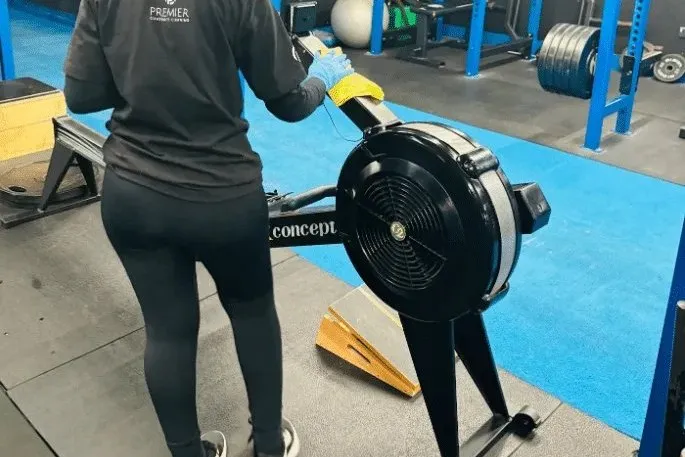
A professional gym clean covers everything members touch, sweat on, and smell. That means equipment and high-touch points disinfected, rubber and sprung floors cleaned, changing rooms, showers and toilets sanitised, mirrors and glass polished, mats, ventilation grilles, high dusting, bins, and restocking. Equipment disinfection and the changing rooms get the most attention, because they drive both hygiene and reputation.

The simple way to think about it: clean what a member sees, then clean what a member feels.

The daily essentials

Day to day, a gym needs a consistent reset. The equipment and high-touch points get disinfected, the floors get cleaned, and the changing rooms, toilets, and mirrors are sorted.

Bins are emptied and supplies restocked. None of it is glamorous. All of it is what keeps members comfortable.

The periodic deep clean

Every so often, the gym needs more than a daily wipe-down. That is where the deep clean comes in.

A deep clean tackles grout and showers, behind and under the equipment, ventilation grilles, a proper floor deep clean, and descaling. This is what stops grime building up in the places a quick clean never reaches.

A typical professional gym clean checklist looks like this:

  • Equipment and high-touch points disinfected
  • Rubber and sprung floors cleaned
  • Changing rooms, showers, and toilets sanitised
  • Mirrors, glass, and mats wiped down
  • Ventilation grilles and high dusting
  • Bins emptied and consumables restocked
  • Periodic deep clean of grout, showers, and behind equipment

For the specifics on soft surfaces and matting, see our guides on commercial carpet cleaning and commercial deep cleaning.

What Do Gyms Use to Clean Rubber Floors?

Gyms clean rubber floors by sweeping or vacuuming up the grit first, then damp mopping with a pH-neutral cleaner diluted in warm water. What you avoid matters just as much. No solvent or oil-based cleaners, no undiluted bleach, and no harsh acids, because they break down the rubber, fade the colour, and leave it sticky. Deal with spills and sweat promptly, and add a periodic deep clean.

That first step is the one people skip. Mopping over grit just grinds it into the surface and dulls the floor.

The right method, step by step

Start by lifting the loose grit with a sweep or a vacuum. Then damp mop with a diluted pH-neutral cleaner, not a soaking wet mop.

Spot-clean spills and sweat as they happen, not at the end of the day. Then build in a periodic deep clean to lift what daily mopping leaves behind.

What to avoid on rubber flooring

This is where expensive floors get quietly ruined. The wrong product does the damage slowly, so you often do not notice until the floor is tacky or faded.

Keep these off your rubber floor:

Safe to use Avoid
pH-neutral cleaner (diluted) Solvent or oil-based cleaners
Warm water and a damp mop Undiluted bleach
Soft brush or microfibre Harsh acids
Prompt spot-cleaning Anything that leaves a sticky residue

What we see on a gym floor: One Dublin gym told us their rubber floor was "ruined and felt permanently tacky." It was not ruined. An oil-based cleaner had been used for months. A switch to a neutral cleaner and a proper rinse brought it back.

What Disinfectants Are Used for Gym Equipment in Ireland?

In Ireland, gyms use disinfectants tested to recognised European (EN) standards, such as EN 1276 for bactericidal activity and EN 14476 for virucidal activity. These are applied to high-touch points and left for the stated contact time before wiping. The product matters less than the method. Cover every touchpoint, respect the dwell time, and disinfect often through the day, not just once.

The standard on the label tells you the product has been tested to actually kill what it claims to. That is what you want on shared equipment.

Why contact time matters most

Here is the part most people get wrong. A disinfectant only works if it stays wet on the surface for its stated contact time.

Spraying and wiping straight away does very little. The surface needs those seconds or minutes to do the job, which is why a rushed wipe-down can look clean but achieve almost nothing.

The high-touch points that matter most

Some surfaces get touched hundreds of times a day. These are the ones to prioritise:

  • Handles, grips, and bars
  • Benches and machine pads
  • Free weights and cable attachments
  • Door handles, lockers, and taps

Daily disinfection versus a deep clean

Through the day, the priority is frequent wiping of those high-touch points. That keeps shared kit safe during peak hours.

On top of that, a deeper periodic sanitisation covers the whole space properly. The two work together, and neither replaces the other.

How Do You Remove the Rubber Smell from Gym Equipment and Floors?

The smell from new rubber equipment and flooring is temporary off-gassing, and it fades fastest with ventilation, time, and a few cleans. Open up the space and run the air handling or fans, wipe the rubber down with a mild soapy or pH-neutral solution, and let it dry. Repeat that over the first days and weeks. The smell weakens steadily, and it is not a sign the rubber is faulty.

We get this call a lot, usually after a new fit-out or a fresh set of mats. The owner worries something is wrong. It almost never is.

Why new rubber smells

New rubber releases a smell from the compounds used to make it. That is the off-gassing you can smell when a floor or a stack of mats is brand new.

It is normal, and it is temporary. The smell is strongest at the start and tails off as the material settles.

How to speed it up

Ventilation does the heavy lifting, so get air moving through the space. A few gentle cleans help lift surface residue, and time finishes the job.

Resist the urge to mask it with heavy chemicals. That just adds a second smell on top of the first and can leave a film on the rubber.

Are Rubber Gym Floors Toxic?

In normal gym use, rubber floors are not considered toxic. The strong smell when they are new comes from temporary VOC off-gassing, which is usually mild and short-lived, and it dissipates with ventilation over days to weeks. For an indoor gym, choose flooring made for indoor use with recognised low-emission certification, ventilate well when it is new, and keep it clean. Anyone with unusual sensitivity should simply make sure there is good airflow.

This worry is understandable, especially with a new floor and a strong smell. But the smell and the risk are not the same thing.

What VOC off-gassing actually is

VOC off-gassing is the release of volatile organic compounds from new materials. With rubber flooring, it is mostly an odour and, for some people, short-term irritation like a stuffy nose.

It is not a lasting hazard in normal use. As the floor settles and the space is ventilated, the emissions drop away.

How to keep it safe and low-odour

A few sensible choices keep things easy:

  • Use indoor-rated flooring with low-emission certification, such as FloorScore or Greenguard type ratings
  • Ventilate well for the first days and weeks
  • Keep the floor clean with the pH-neutral routine above
  • Avoid outdoor or stall-type matting indoors, as it is not made for enclosed spaces

If a member has a genuine sensitivity, good ventilation is the answer, and if symptoms persist, a quick chat with their GP is the sensible step.

How Do You Prevent Mould and Odour in a Changing Room?

Prevent changing-room mould and odour by controlling moisture, because mould and smell both feed on damp. That means good ventilation and extraction, drying down wet surfaces, fixing leaks and pooling water, cleaning and disinfecting showers, grout, and floors daily, and emptying bins often. Tackle the source, not the symptom, because air freshener over a damp room just hides the problem for an hour.

Changing rooms are the hardest part of any gym to keep fresh. Warm, wet, and busy is exactly what mould and odour want.

Control the moisture first

Damp is the root cause, so start there. Good ventilation and extraction pull moisture out, drying down wet surfaces stops it settling, and fixing leaks removes the standing water that smells.

In a persistently damp room, a dehumidifier earns its keep. Get the moisture down and half the battle is already won.

Clean the smell at source, don't mask it

Once moisture is under control, clean the places the smell actually comes from. That means showers, grout, drains, floors, lockers, and bins, disinfected daily, with a periodic deep clean of the grout.

Grout is the usual hiding place. It is porous, it holds moisture, and it is where that "I have cleaned everything but it still smells" odour often lives.

How to make a gym smell genuinely good

The order matters here. Remove the source, bring in fresh air, then clean the soft surfaces that hold smell.

Only after that does scent have a place, and only as a finish, never as the fix. A light, pleasant scent over a genuinely clean room works. The same scent over a damp one just buys you an hour.

What we find in a changing room: A Dublin gym was convinced they had a "bad drain" smell. The drains were fine. It was grout that needed a deep clean and a shower area with poor airflow. Sorted both, and the smell was gone.

What Does Toxic Mould Smell Like, and What Are the Signs?

Mould usually smells musty, earthy, or damp, a bit like wet cardboard or an old cellar. That smell comes from the gases mould gives off as it grows. People exposed to a lot of indoor mould sometimes report symptoms such as a blocked or runny nose, sneezing, coughing, a sore throat, itchy or watery eyes, headaches, tiredness, skin irritation, or trouble concentrating. These signs are general and have many causes, so if they persist, it is best to see a GP rather than self-diagnose.

We are cleaners, not doctors, so we will keep this measured. A musty smell is mainly a signal to act, not a reason to panic.

The musty "tell" smell

That earthy, damp smell is often the first warning, before you can see anything. It is worth trusting your nose here.

If a room smells musty even after a clean, there is usually hidden moisture feeding something. That is the cue to find the source.

Commonly reported symptoms (and the honest caveat)

The symptoms people commonly link to indoor mould include:

  • Blocked or runny nose and sneezing
  • Coughing and a sore throat
  • Itchy or watery eyes
  • Headaches and tiredness
  • Skin irritation
  • Trouble concentrating

Here is the honest part. These symptoms have many possible causes, and this is not a diagnosis. If you or your members notice them persisting, the right step is a GP, not a guess. What we can do is remove the conditions that let mould grow in the first place.

What Kills Mould "Instantly," and When Is It a Specialist Job?

There is no product that kills mould "instantly," despite what the labels promise. Surface mould on hard, non-porous areas like tiles and grout can be cleaned with a suitable disinfectant or a vinegar solution. But it always comes back unless you fix the moisture causing it. Extensive or black mould on porous materials, or mould that keeps returning, needs professional remediation and a proper damp diagnosis, not a spray.

We would rather tell you this straight than sell you a quick fix that fails. The "instant mould killer" is mostly marketing.

Surface mould you can clean

On hard, non-porous surfaces, surface mould is manageable. Use the right disinfectant or a vinegar solution, scrub it, and dry the area properly.

But cleaning it is only half the job. If you do not fix the moisture source, it will be back within weeks. The clean treats the symptom. The moisture is the cause.

When to call a specialist

Some situations are beyond routine cleaning, and it pays to know the difference:

  • Large affected areas
  • Mould in porous materials like plaster or timber
  • Growth that keeps coming back after cleaning
  • Any sign of structural damp

In those cases, you need a remediation specialist and a damp diagnosis. Our routine and deep cleaning controls moisture and removes surface mould, which prevents most problems. It does not replace specialist remediation when the issue runs deeper, and we will always tell you when that is the case.

When Should You Schedule Gym Cleaning?

Schedule gym cleaning for before opening, overnight, or during quiet hours, so members never see the work. Most Dublin gyms need daily cleaning of equipment, floors, and changing rooms, with a periodic deep clean on top. High footfall makes daily the baseline, with extra attention to the changing rooms and showers.

The aim is simple. Members should only ever see the result, never the mop.

After-hours and pre-opening scheduling

We work around your hours, not the other way round. Early mornings, late evenings, and quiet windows keep the gym open and members undisturbed.

You arrive to a fresh, reset space ready for the first session of the day.

Daily plus periodic deep clean

The daily clean keeps standards from slipping between sessions. It is the reset that stops grime and odour building up.

The periodic deep clean does the rest, resetting grout, showers, and floors before they ever become a problem. Together they keep a busy gym consistently fresh.

Why Dublin Gyms Choose Premier Contract Cleaning

We have spent almost a decade keeping Dublin gyms, studios, and fitness spaces fresh and hygienic, from boutique PT studios to busy commercial gyms. We know that in a gym, hygiene is the product, and members vote with their memberships.

Here is how we work with you:

  • Equipment and high-touch points disinfected to EN standards, rubber and sprung floors cared for, and fresh, mould-free changing rooms
  • The right products and method: pH-neutral floor care, EN-standard disinfectants used with proper contact time, and moisture-first odour and mould control
  • After-hours and flexible schedules, so your gym is always open and always fresh
  • Honest advice: we prevent and remove surface mould and control the damp that causes it, and we will tell you straight when something needs a remediation specialist
  • Almost a decade of experience, trained staff, transparent ERO-compliant pricing, eco-friendly products, and our redo-it-free guarantee

So if your changing rooms never quite smell right, or you just want the whole place kept member-ready without the hassle, let us take a look.

Keep your gym fresh, hygienic, and member-ready. Book a free site survey and cleaning plan. Call 086 083 6141, or request a free quote online.

Internal link suggestions: Link to the Gym Cleaning service page, Commercial Cleaning Services Dublin, the companion commercial deep cleaning guide, Commercial Carpet Cleaning, Commercial Window Cleaning in Dublin, and Contact.

Frequently Asked Questions

What is included in a professional gym cleaning service? Equipment and high-touch points disinfected, rubber and sprung floors cleaned, changing rooms, showers, and toilets sanitised, mirrors and glass, mats, ventilation grilles, high dusting, bins, and restocking, plus a periodic deep clean. Equipment and changing rooms get the most attention.

What do gyms use to clean rubber floors? Sweep or vacuum the grit first, then damp mop with a pH-neutral cleaner diluted in warm water. Avoid solvent and oil-based cleaners, undiluted bleach, and harsh acids, which break down the rubber, fade the colour, and leave it sticky.

What disinfectants are used for gym equipment in Ireland? Disinfectants tested to recognised EN standards, such as EN 1276 for bacteria and EN 14476 for viruses, applied to high-touch points and left for the stated contact time before wiping. Method matters more than the brand, so cover every touchpoint and disinfect often.

How do you remove the rubber smell from gym equipment? The smell is temporary off-gassing from new rubber. Ventilate the space, wipe the rubber with a mild soapy or pH-neutral solution, let it dry, and repeat over the first days and weeks. The smell fades steadily and is not a sign of a fault.

Are rubber gym floors toxic? In normal use, no. The new-floor smell is temporary VOC off-gassing, usually mild and short-lived, and it clears with ventilation over days to weeks. Choose indoor-rated, low-emission certified flooring, ventilate well when new, and keep it clean.

How do you prevent mould and odour in a changing room? Control the moisture first with good ventilation, dry surfaces, and fixed leaks, then clean and disinfect showers, grout, drains, floors, and bins daily. Tackle the source rather than masking it, because air freshener over a damp room only hides the smell briefly.

How do you make a gym smell good? Remove the source of the smell, bring in fresh air, and clean the soft surfaces that hold odour. Only then add a light scent as a finish. Scent works over a genuinely clean space, but never as a substitute for fixing damp or dirt.

What does toxic mould smell like? Mould usually smells musty, earthy, or damp, like wet cardboard or an old cellar. That smell comes from the gases mould releases as it grows, and it is often the first sign of a problem before any growth is visible.

What kills mould instantly? Nothing kills mould instantly. Surface mould on hard, non-porous areas can be cleaned with a disinfectant or vinegar solution, but it returns unless you fix the moisture. Extensive, porous, or recurring mould needs professional remediation, not a spray.

What are the signs of mould toxicity? People exposed to indoor mould sometimes report a blocked nose, sneezing, coughing, sore throat, itchy eyes, headaches, tiredness, skin irritation, or difficulty concentrating. These are general and have many causes, so if symptoms persist, see a GP rather than self-diagnosing.

How often should a gym be cleaned? Most Dublin gyms need daily cleaning of equipment, floors, and changing rooms, with a periodic deep clean on top. High footfall, sweat, and shared kit mean daily is the baseline, with extra attention to changing rooms and showers.


Catalin Fatul - Founder, Premier Contract Cleaning

Catalin Fatul is the founder and expert behind Premier Contract Cleaning, dedicated to providing top-notch cleaning solutions and tips. With a passion for cleanliness and a commitment to quality, Catalin brings years of experience in the cleaning industry to help readers maintain pristine spaces. Whether it's offering the latest cleaning hacks or recommending the best products, Catalin's mission is to make cleaning efficient, effective, and enjoyable.

May 25, 2026
Eco-Friendly Commercial Cleaning in Dublin: Are Green Products as Effective and Is It Worth the Switch?

By the team at Premier Contract Cleaning. Dublin's trusted commercial cleaning company, cleaning offices and corporate spaces with eco-friendly products for almost a decade. Most managers who ask us about green cleaning have the same quiet worry. They want to do the right thing, and they want the cleaning to match their sustainability goals. But […]

Read More
May 21, 2026
Commercial Gutter Cleaning in North Dublin: How Professionals Work at Height and Why Annual Inspections Matter

By the team at Premier Contract Cleaning. Dublin's trusted commercial cleaning company, clearing gutters safely for offices, units, and commercial buildings across Dublin for almost a decade. A facilities manager rang us about a two-storey unit with gutters overflowing after a wet week. One quote on the desk had a small fortune in scaffolding built […]

Read More
May 18, 2026
Business Cleaning in Dublin: Monthly Costs, What's Included and How to Set Up a Regular Schedule

By the team at Premier Contract Cleaning. Dublin's trusted commercial cleaning company, keeping businesses across the city clean and presentable on a regular schedule for almost a decade. Most business owners do not want a lecture on cleaning. They want it sorted. They have decided the office, shop, or unit needs a regular clean, and […]

Read More
May 18, 2026
How to Choose a Commercial Cleaning Company in Dublin: 5 Questions Every Business Should Ask

By the team at Premier Contract Cleaning. Dublin's trusted commercial cleaning company, keeping offices and corporate spaces spotless across the city for almost a decade. Three quotes on the desk, and one of them is noticeably cheaper than the rest. It is a familiar scene, and the cheap one is tempting. But after almost a […]

Read More

© Premier Contract Cleaning 2026. All Rights Reserved. | Maintained By Hairgrass Digital

linkedin facebook pinterest youtube rss twitter instagram facebook-blank rss-blank linkedin-blank pinterest youtube twitter instagram