

A showroom manager on a main road on Dublin's southside rang us at 7.40am one morning. He had just opened up to find silver tag lines sprayed across his fascia and a crack running through one glass panel. His first instinct, he admitted later, was to send a staff member out with a bottle of […]
Steam Cleaning vs Dry Cleaning: Which Is Best for High-Traffic Commercial Carpets in Dublin?
By the team at Premier Contract Cleaning. Dublin's trusted commercial cleaning company, keeping office, retail, and corporate carpets looking their best across the city for almost a decade.
It is the question we get asked more than almost any other.
A facilities manager has two quotes on the desk, one for "steam," one for "dry," a lobby carpet with grey lanes worn into the walkways, and no idea which one is right.
After almost a decade cleaning Dublin commercial carpets, our honest answer tends to surprise people. It is not steam or dry. The best-looking, longest-lasting high-traffic carpets we look after use both, in a simple programme.
Here is how the two methods really differ, when to use each, how often your carpet needs it, and what we actually use to keep traffic lanes from greying up.
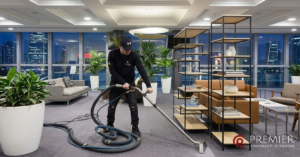
Steam Cleaning vs Dry Cleaning: Which Is Best for High-Traffic Commercial Carpet?
Neither one wins outright. For high-traffic commercial carpet, the best results come from combining both. Low-moisture (dry) cleaning handles frequent interim maintenance, because it dries in under an hour and causes no downtime. Periodic hot water extraction (steam) handles deep restoration, because it flushes out the embedded soil that builds up in traffic lanes. Steam cleans deepest, dry dries fastest, and a good programme uses each for what it does best.
So when someone asks us to pick a winner, we gently push back. The right question is not "which method," it is "which method, for which job, how often."
What "steam cleaning" actually means
Here is a detail most people get wrong, and it is worth clearing up. "Steam cleaning" is not really steam.
The method is hot water extraction. Hot water and a cleaning solution are injected into the carpet, then immediately vacuumed back out along with the dirt.
It is the deepest, most restorative clean there is, and the one most carpet manufacturers recommend for a full clean. The trade-off is that it puts moisture into the carpet, so it takes longer to dry.
What "dry cleaning" actually means
Dry cleaning is a slight misnomer too. It is really low-moisture cleaning, and it covers a few different methods.
The common ones are encapsulation, bonnet, and dry compound. They clean the surface to medium depth, use very little water, and dry fast.
That speed is the whole point. A low-moisture clean can have a floor back in use within the hour.
Here is how they compare at a glance:
| Steam (hot water extraction) | Dry (low-moisture) | |
| Cleaning depth | Deepest, restorative | Surface to medium |
| Drying time | Several hours | Often under an hour |
| Downtime | Best after hours | Minimal, clean almost anytime |
| Best for | Periodic deep clean, traffic lanes | Frequent interim maintenance |
| Typical frequency | Every few months | Monthly or as needed |
What Is the Best Method for Commercial Carpet Cleaning?
The best method for commercial carpet is a layered programme, not a single technique. That means daily vacuuming, regular low-moisture interim cleaning to hold the appearance, and periodic hot water extraction to deep-clean, all matched to how much traffic the carpet takes. The Carpet and Rug Institute and most carpet manufacturers recommend this combination, because it keeps carpet looking good and lasting longer than any one method on its own.
Think of it like looking after a car. You wash it regularly to keep it looking sharp, and you service it now and then to keep it running. Carpet is the same.
Why a combination beats picking one
Interim low-moisture cleaning keeps the surface clean and stops soil building up in the first place. It is the regular "wash."
Periodic hot water extraction is the "service." It reaches the embedded grit that interim cleaning leaves behind and resets the carpet.
Do only the deep cleans and the carpet looks tired between them. Do only the surface cleans and the deep soil slowly grinds away the fibre. Together, they keep the carpet looking better and lasting years longer.
Matching the method to your space
There is no single right mix. It depends on three things: how much traffic the carpet takes, the type of fibre, and how much downtime you can tolerate.
A quiet back office is not on the same plan as a busy reception. That is exactly what we work out on a site survey before we recommend anything.
What we see on a commercial floor: A Dublin office once told us their lobby carpet was "worn out and needs replacing." It was not worn out. A proper extraction lifted years of embedded grit, and a monthly encapsulation routine kept it looking sharp. They kept the carpet.
When Should You Use Steam Cleaning (Hot Water Extraction)?
Use steam cleaning for periodic deep, restorative cleaning. That is the moment when traffic lanes have greyed, soil is embedded, or the carpet just needs resetting. It is the most thorough method, and the one manufacturers recommend for a full clean. The trade-off is drying time, so it is best scheduled after hours or at weekends, so the area is dry and back in use by the time you open.
This is the heavy lifting of carpet care. It is not something most floors need every week, but every floor needs it eventually.
The deep-clean advantage
Hot water extraction flushes out what a surface clean simply cannot reach. The grit, the oils, the old detergent residue, all of it gets rinsed out and vacuumed away.
That is why it works so well on greyed traffic lanes. The grey is embedded soil, and extraction is what lifts it.
The drying trade-off, and how we manage it
The honest downside is moisture. A steam-cleaned carpet is damp for a few hours afterwards.
We manage that two ways. We use strong extraction and air movers to pull out as much water as possible, and we schedule the work after hours. You leave a damp carpet in the evening and arrive to a dry, fresh one in the morning.
When Should You Use Dry (Low-Moisture) Cleaning?
Use dry, low-moisture cleaning for frequent interim maintenance, when you need the carpet clean and back in use fast. Methods like encapsulation dry in under an hour, so a floor can be cleaned overnight or even in a quiet window during the day and walked on almost straight away. It keeps the appearance high between deep cleans, which is ideal for a busy premises that cannot close.
For most of our Dublin clients, this is the method doing the day-to-day work. The deep clean is the occasional event. The low-moisture clean is the routine that keeps things looking good in between.
Encapsulation, bonnet, and dry compound explained
These three get lumped together as "dry," but they work differently:
- Encapsulation: a polymer solution surrounds the soil and dries into tiny crystals, which are then vacuumed away. Fast-drying and great for regular maintenance.
- Bonnet: an absorbent pad spins on a low-speed machine to lift surface soil. Quick, and handy between deep cleans.
- Dry compound: an absorbent powder is brushed through the fibre and vacuumed out, with almost no drying time at all.
Why low-moisture suits an always-open business
The appeal is simple. There is barely any downtime, the carpet dries fast, and because you can clean often, soil never gets the chance to embed.
That last point matters more than people realise. Frequent interim cleaning is genuinely preventative. It stops the deep soiling that wears carpet out.
How Often Should Commercial Carpets Be Cleaned?
Vacuum daily, run a low-moisture interim clean regularly (monthly for high-traffic areas, less often for quieter zones), and book a deep hot water extraction every three to six months for high-traffic carpet, or every six to twelve months for general commercial areas. The simple rule is that the busier the carpet, the more often it needs attention, and lobbies, corridors, and retail floors sit at the frequent end.
There is no one-size answer, but there is a sensible baseline. Daily vacuuming is non-negotiable, because most carpet wear is dry grit being ground into the fibre.
High-traffic areas (lobbies, corridors, retail, reception)
These take the most punishment, so they need the most care. Vacuum daily, run an interim low-moisture clean roughly monthly or more, and book a deep extraction every three to six months.
These are the zones clients and staff see first. They are also the first to grey up, so they earn the extra attention.
General commercial and office areas
Quieter zones can relax the schedule. A deep clean every six to twelve months usually does it, with interim cleaning as needed.
A meeting room used twice a week is simply not the same as a front door. Match the frequency to the footfall.
Here is a simple guide:
| Area | Vacuum | Interim (low-moisture) | Deep clean (extraction) |
| Lobbies, corridors, retail, reception | Daily | Monthly or more | Every 3 to 6 months |
| General offices | Daily | As needed | Every 6 to 12 months |
| Low-traffic / quiet rooms | Regularly | Occasionally | Every 12 months |
For the full picture on cost and drying times, see our main guide to commercial carpet cleaning.
How Do You Clean Heavy-Traffic Areas and Traffic Lanes on Carpet?
Clean heavy-traffic areas by stopping soil at the source with good entrance matting, vacuuming frequently, then pre-spraying and agitating the traffic lanes before extraction, so the embedded grit lifts out. Between deep cleans, keep the lanes fresh with low-moisture interim cleaning, and treat spots the moment they happen. Most traffic-lane greying is dry soil ground into the fibre, so the key is lifting it, not just wetting it.
Traffic lanes are where carpets show their age first. They are also the most fixable, once you treat them properly.
Stop the soil at the source
The cheapest carpet cleaning you will ever do is stopping the dirt before it arrives. Good entrance matting traps most of the grit and water at the door.
Pair that with frequent vacuuming and you remove the dry soil before it gets walked deep into the fibre. Half the battle is won here.
Treating the traffic lanes
For the lanes themselves, wetting alone does not cut it. We pre-spray the lane, agitate it to loosen the embedded grit, then extract.
Between deep cleans, a low-moisture interim clean keeps the lane from greying back up. And spots get treated straight away, because a fresh spill lifts far more easily than a set-in stain.
A simple high-traffic carpet routine:
- Quality entrance matting at every door
- Vacuum daily, more in the busiest lanes
- Pre-spray and agitate traffic lanes before extraction
- Interim low-moisture cleaning between deep cleans
- Treat spills the moment they happen
What we see on a commercial floor: One Dublin corridor greyed up no matter how often it was vacuumed. The fix was not more vacuuming. It was better matting at the entrance plus a monthly lane clean, and the grey path stopped coming back.
What Carpet Cleaner Do Professionals Use?
Professionals use commercial-grade machines, truck-mounted or portable hot water extractors for deep cleaning and low-speed rotary or encapsulation machines for interim cleaning, paired with CRI Seal of Approval detergents, encapsulation polymers, traffic-lane pre-sprays, and spotters. The products are matched to the carpet fibre, used at the right dilution, and chosen to be low-residue, because leftover residue is exactly what makes a carpet re-soil quickly.
This is the part that separates a proper clean from a quick one. The machine and the product both matter, and so does how they are used.
The machines
For deep cleaning, we use hot water extractors, either truck-mounted or strong portable units, that inject and recover water in one pass. For interim cleaning, low-speed rotary and encapsulation machines do the job with minimal moisture.
The right machine for the right job. That is most of the skill.
The products
On the chemical side, we lead with CRI Seal of Approval detergents, encapsulation polymers, traffic-lane pre-sprays, and enzyme spotters. Everything is matched to the carpet fibre and used at the correct dilution.
The most important quality is low residue. A cheap, high-residue product leaves a sticky film that pulls dirt straight back in, so the carpet looks clean for a week, then worse than before. Low-residue cleaning is why a professional clean stays clean.
Why Dublin Businesses Choose Premier Contract Cleaning
We have spent almost a decade keeping Dublin commercial carpets looking their best, from busy office receptions to retail floors and corporate corridors. We know that in a high-traffic space, the carpet is on show every single day.
Here is how we work with you:
- An honest method verdict, the right machines and CRI-approved products, and a programme matched to your traffic
- Both methods under one roof: low-moisture interim cleaning for appearance and zero downtime, plus periodic hot water extraction for deep restoration
- After-hours and flexible schedules, so carpets are cleaned overnight and dry and ready by opening
- Almost a decade of experience, trained staff, transparent ERO-compliant pricing, eco-friendly products, and our redo-it-free guarantee
We do not push one method, because the best result almost always uses both. We have seen too many good carpets written off early when a proper programme would have saved them.
So if your traffic lanes are greying up, or you just want the carpets kept sharp without ever closing a floor, let us take a look.
Keep your high-traffic carpets looking their best. Book a free site survey and a carpet-care plan. Call 01 963 6655, or request a free quote online.
Internal link suggestions: Link to Commercial Carpet Cleaning (for cost and the full service), Commercial Cleaning Services Dublin, Office Cleaning Dublin, the companion commercial deep cleaning guide, and Contact.
Frequently Asked Questions
Which is better, steam or dry carpet cleaning? Neither is better outright. Steam (hot water extraction) cleans deepest and is best for periodic restoration, while dry (low-moisture) cleaning dries fast and is best for frequent interim maintenance. For high-traffic commercial carpet, a programme that combines both gives the best result.
What is the best method for commercial carpet cleaning? A layered programme, not one method. Daily vacuuming, regular low-moisture interim cleaning to hold appearance, and periodic hot water extraction for a deep clean, all matched to traffic. This combination keeps carpet looking good and lasting longer than any single method.
What is the best way to clean commercial carpet? Stop soil at the door with matting, vacuum daily, keep the surface fresh with regular low-moisture cleaning, and deep-clean periodically with hot water extraction. Match the frequency to the traffic, and treat spills the moment they happen.
How often should commercial carpet be cleaned? Vacuum daily, run an interim low-moisture clean as needed, and book a deep hot water extraction every six to twelve months for general commercial areas. Busier areas need it more often. A site survey sets the right schedule for your building.
How often should high-traffic commercial carpets be cleaned? High-traffic areas like lobbies, corridors, and retail floors need an interim low-moisture clean roughly monthly or more, plus a deep hot water extraction every three to six months, on top of daily vacuuming. The heavier the footfall, the more frequent the cleaning.
What carpet cleaner do professionals use? Commercial-grade hot water extractors and low-speed rotary or encapsulation machines, paired with CRI Seal of Approval detergents, encapsulation polymers, pre-sprays, and spotters. The products are matched to the fibre and low-residue, so the carpet does not re-soil quickly.
How do you clean heavy-traffic areas on carpet? Stop grit at the door with matting, vacuum frequently, then pre-spray and agitate the traffic lanes before extraction. Keep the lanes fresh with interim low-moisture cleaning between deep cleans, and treat spots straight away. Greying is embedded soil, so the key is lifting it.
Is steam cleaning bad for commercial carpet? No, when it is done properly. Hot water extraction is the method manufacturers recommend for a deep clean. The only risk is over-wetting from a poor job, which is why strong extraction, good airflow, and after-hours scheduling matter.
How long does commercial carpet take to dry after cleaning? Low-moisture cleaning usually dries in under an hour. Hot water extraction takes several hours, sometimes longer in damp conditions, which is why we schedule it after hours with strong extraction and air movers so it is dry by opening.
Can you clean our carpets after hours? Yes. We schedule overnight, in the evenings, or at weekends, so the work never disrupts your business. You leave a busy floor in the evening and arrive to clean, dry carpets in the morning.

The fire itself lasted minutes. An electrical fault in a printer corner of a Dublin 2 office, caught early, out before the fire brigade even finished checking the building. The soot was a different story. The next morning the office manager found a grey film on desks two rooms away and black webs hanging in […]
A few winters ago, our phone rang at ten past six in the morning. A facilities manager on the other end, standing outside a ground floor office near the Dodder, trying to keep his voice level. The water had come in overnight and gone back out on its own. What it left behind was worse […]
A property manager at a multi tenant office block near Grand Canal Dock rang us on a Tuesday, standing in the bin store while he talked. The mixed dry recycling for the whole building had been tagged as contaminated two collections running, with a surcharge attached both times, and now the bin was overflowing into […]