

A showroom manager on a main road on Dublin's southside rang us at 7.40am one morning. He had just opened up to find silver tag lines sprayed across his fascia and a crack running through one glass panel. His first instinct, he admitted later, was to send a staff member out with a bottle of […]
What to Do When an EHO Issues an Improvement Notice on Hygiene
A cafe owner near the city centre quays rang us at about half ten one morning. An Environmental Health Officer had visited the previous afternoon and left an improvement notice listing grease accumulation behind the cooking line, build up on the extraction canopy, and a cleaning schedule that, in the officer's words, was not being followed in practice.
He was not really ringing about cleaning. He was ringing because he had been awake since four in the morning convinced he was going to be closed down and named on a list.
He was not closed down. We surveyed the premises that afternoon, deep cleaned across two nights after service, and handed him a dated photo log to give to the officer. The cafe never shut for a single hour. That is a more typical outcome than the internet would have you believe, and it is worth saying early.
The Short Answer: What an Improvement Notice Means and What to Do
An EHO improvement notice means an officer believes conditions or practices at your premises are likely to pose a risk to public health. It is not a closure. Read the notice, note the remedial actions and time limit, fix everything listed, keep evidence, and be ready for re-inspection.
An improvement notice is the lowest rung of the enforcement ladder. It is the officer telling you what needs to change and giving you time to change it. Businesses that act quickly and communicate well almost always resolve them without escalation.
The two things that turn a manageable notice into a serious problem are silence and delay. Neither costs anything to avoid.
Who Issues Improvement Notices in Ireland and Under What Law
The HSE Environmental Health Service and the FSAI
The officer who visited you is an authorised officer. In most food premises in Ireland that means an Environmental Health Officer from the HSE's National Environmental Health Service, working under a service contract with the Food Safety Authority of Ireland. The FSAI is the national authority; the HSE officers are the people on the ground carrying out inspections and enforcement.
That distinction matters for one practical reason. Your conversation about the notice is with the officer who served it, not with the FSAI.
The FSAI Act 1998 and What the Notice Must State
Improvement notices are served under section 52 of the Food Safety Authority of Ireland Act 1998. A valid notice must identify the activity or the defect in the premises giving rise to the risk, require remedial action and specify the nature of that action where appropriate, and set a time limit for completion.
There is no fixed statutory minimum period. FSAI guidance is that the time limit should be reasonable given the amount and nature of the work required, and proportionate to the risk to public health. A serious grease hazard will carry a shorter deadline than a paperwork failing, and that is deliberate.
One piece of reassurance that a lot of operators do not know: improvement notices are not published on the FSAI website. Closure orders, prohibition orders and improvement orders are published in the FSAI's enforcement reports. An improvement notice, dealt with properly, stays between you and the officer.

Improvement Notice, Improvement Order, Closure Order: The Escalation Ladder
Picture it as four rungs rather than one cliff edge.
| Stage | Who issues it | What triggers it | Published by FSAI | Appeal |
| Improvement notice | Authorised officer | Conditions or practices likely to pose a risk to public health if they persist | No | No direct appeal against the notice itself |
| Improvement order | District Court, on application | Failure to comply with an improvement notice | Yes, listed for three months after the order is lifted | Court process, take legal advice |
| Closure order | Authorised officer | Grave and immediate danger to public health, or failure to comply with an improvement order | Yes, listed for three months after the order is lifted | 7 days from service, to the District Court |
| Prohibition order | Authorised officer | Activity involving food that involves or is likely to involve a serious risk to public health | Yes, listed for one month after the order is lifted | 7 days from service, to the District Court |
Two points worth understanding properly.
There is no direct statutory appeal against an improvement notice itself. If you believe the notice is wrong, the route is to engage with the officer, not to lodge an appeal. Where you dispute it seriously, take legal advice immediately rather than waiting to see what happens. If the matter proceeds to the District Court for an improvement order, that is where the legal argument happens.
A closure order can be served at any time. It does not require an improvement notice first. Where an officer forms the view that there is a grave and immediate danger to public health, they can act on the spot. This is why "we'll get to it next month" is such a bad plan when the notice mentions anything that could deteriorate.
The seven day appeal window on closure and prohibition orders is short and it runs from the day the order is served. If you are ever in that position, ring a solicitor the same day.
Your First 24 Hours: A Step by Step Response Plan
Step 1. Read the notice line by line and photograph everything
Read it twice, slowly, with a pen. Write down each individual item as a separate task, because a single sentence often contains three jobs. "Accumulated grease deposits to walls, floor junctions and equipment in the kitchen area" is three different cleaning operations.
Then photograph every area mentioned, before anyone touches anything. Dated before photographs are the foundation of your compliance evidence and you cannot go back for them later.
Step 2. Confirm the deadline and re-inspection expectations with the EHO
Ring the officer. This is the step people avoid and it is the one that changes outcomes most.
Be straightforward: you have received the notice, you take it seriously, here is your plan and your timeline, and you want to check you have understood each item correctly. Ask whether they intend to re-inspect and roughly when.
Officers deal with two kinds of operator: the ones who engage and the ones who go quiet. You want to be visibly in the first group from day one.
Step 3. Triage: what needs a contractor and what your team can do tonight
Split the list into three.
Tonight, in house. Surface cleaning, decluttering, bin discipline, fridge and store tidying, anything your own staff can do properly this evening.
Specialist cleaning. Heavy degreasing, behind and under fixed equipment, extraction canopies and filters, high level surfaces, cold room seals, wall and floor junctions. These need equipment, chemicals and time your team does not have mid service.
Repairs and trades. Damaged surfaces, failed seals, broken tiling, a fridge that will not hold temperature. A cleaner cannot fix a defect, and a notice item that is structural needs a tradesperson booked immediately.
Do the in house work tonight regardless. It shows willing, and it makes the specialist work faster.
Step 4. Book the remedial deep clean and any repairs
Book it now rather than after you have compared five quotes. Deadlines on notices are not generous, and availability for overnight kitchen work in Dublin is finite.
When you brief the cleaning contractor, give them the notice itself rather than a summary. The wording tells an experienced team exactly what to scope. Ask for the work to be photographed as it goes, and ask for a written scope of works you can hand to the officer.
Step 5. Update your HACCP cleaning schedule and records
This is the item most often missed, and it is frequently the real reason the notice was served.
A great many hygiene notices are not only about dirt. They are about a food safety management system that says one thing while the premises say another. If your documented cleaning schedule specifies weekly canopy cleaning and the canopy plainly has not been touched in months, the officer has found a system failure as well as a hygiene failure.
So rewrite the schedule so it reflects what will actually happen. Assign each task to a role rather than a name. Set frequencies you can genuinely sustain. Sign the records as the work is done, not in a batch on Friday afternoon. Records that are obviously filled in retrospectively do more harm than no records at all.
If you would like this scoped properly by people who do it weekly, our site survey is free and we can usually get to a Dublin premises within a day or two.
What a Remedial Hygiene Deep Clean Actually Covers
Notice wording is deliberately general. Here is what it translates to in practice.
Kitchens and Food Prep Areas
Full degreasing of cooking lines, including behind and underneath fixed equipment where the heaviest build up sits. Wall and floor junctions, which is where officers look first and where mop and bucket cleaning never reaches. Splashbacks, shelving, undersides of prep benches, equipment feet and castors. Cold room and fridge seals, where mould establishes quietly in the rubber. Drains and gullies.
Extraction, High Level Surfaces and Behind Equipment
Canopy interiors, filters, and the accessible sections of ductwork. Grease in extraction is a fire risk as well as a hygiene one, and it is one of the most commonly cited items on notices we see. High level surfaces, pipework, light fittings and ceiling voids where dust and grease combine into something that eventually drops.
Moving fixed equipment out to clean behind it is the single job that changes how a kitchen looks to an inspector, and it is the one job a busy kitchen team almost never gets to.
Bins, Yards and Shared Areas
Bin store washdown and sanitisation, external bin areas, yards, and the route between the kitchen and the bins. Pest attracting debris in a shared yard is a legitimate notice item even when your kitchen is spotless.
We work out of hours as standard, so a remedial clean happens after service and the business trades normally the next day. Products used in food areas are chosen to be appropriate for food environments, and we use eco friendly options wherever they perform to the standard required.
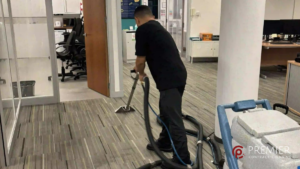
A Real Example From Our Team
Back to the cafe on the quays.
We surveyed at three in the afternoon, between lunch and close, and walked the premises with the notice in hand item by item. That walk took forty minutes and it is the part that makes everything afterwards work, because we scoped against the officer's actual wording rather than our own assumptions.
The clean ran over two nights after close. Night one was the cooking line, the extraction canopy and filters, and the wall and floor junctions through the kitchen. Night two was cold rooms and seals, high level surfaces, the store room, and the bin store and yard. We photographed each area before and after, in the same frame and the same angle, and put the set into a dated log with a written scope of works.
The owner handed that log to the officer along with his revised cleaning schedule. The re-inspection was straightforward.
Catalin, who founded the company, still reviews the photo log on a remedial clean before it goes to a client, because it is the document the client's compliance rests on and it needs to be right. The cafe moved onto a weekly contract clean afterwards, which is the part that actually prevents the next notice.
[Image suggestion: before and after degrease of a cooker line. Alt text: "remedial deep clean behind kitchen equipment after an improvement notice"]
The Dublin Angle: Local Realities That Affect Your Notice
Dublin adds complications that generic guidance never mentions.
Shared yards and bin stores. A great many city centre food businesses share waste areas with other tenants, managed by a building management company or an Owners Management Company. If your notice cites the bin area and you do not control it, you still need to respond, and the answer usually involves the managing agent as well as a cleaning contractor. Put that request in writing so you have a record of having raised it.
Older buildings on and around the quays. Georgian and Victorian conversions were not designed as commercial kitchens. Awkward voids, boxed pipework, uneven floor junctions and shared extraction routes all create places grease accumulates faster than anyone expects. If you trade from one of these, your cleaning frequencies need to be higher than the textbook.
Landlord and lease obligations. In a multi tenant building, extraction ducting and grease traps are often a landlord responsibility. Check your lease before you pay for something that is not yours to fix, but do not let that argument delay the work while a deadline runs.
Waste presentation. Dublin City Council bye-laws govern how commercial waste is stored and presented, and bin area hygiene sits at the overlap between waste rules and food hygiene. Getting the bin routine right solves two problems at once.
This is not only a restaurant issue, incidentally. We have carried out remedial cleans in creche kitchens and office canteens where the same standards apply and the operators had not realised they were in scope.
Costs, Insurance and Preventing the Next Notice
What Remedial Cleaning Costs Depend On
Anyone quoting you without seeing the premises is guessing. The real drivers are floor area, the grease load and how long it has been building, how much fixed equipment has to be moved, whether extraction is included and how accessible it is, whether the work runs overnight, and how many nights it takes.
A small cafe kitchen and a hotel production kitchen are different orders of magnitude. Get someone to walk it.
Will Insurance Cover Any of This
Generally, no. Remedial cleaning to correct a hygiene failing is maintenance, not an insured loss, and policies do not typically respond to it. There can be exceptions where the underlying cause was itself an insured event, such as a flood or a fire, but that is a different conversation. Check with your broker rather than assuming either way.
Prevention: Schedules, Records and a Cleaning Contract
The businesses that get a second notice are almost always the ones that treated the first as a one off event rather than a signal.
Scheduled contract cleaning fixes the underlying problem in two ways. The work happens on a frequency that keeps ahead of build up, and it generates signed, dated records automatically. When the officer next asks how often the canopy is cleaned, you have an answer with a date on it rather than an assurance.
Set periodic deep cleans on a diary rather than on memory. Quarterly is a common starting point for a busy kitchen, more often where the cooking is heavy.
FAQ: EHO Improvement Notices in Ireland
What is the difference between an improvement notice and an improvement order in Ireland? An improvement notice is served by an authorised officer and requires remedial action within a stated time limit. An improvement order is made by the District Court, generally where an improvement notice has not been complied with. The order is the escalation, and it is published by the FSAI.
Is an EHO improvement notice made public in Ireland? No. Improvement notices are not published on the FSAI website. Improvement orders and closure orders appear in the FSAI enforcement reports and remain listed for three months after being lifted, while prohibition orders remain listed for one month after being lifted.
How long do I have to comply with an improvement notice? The notice itself specifies the time limit. There is no fixed statutory minimum. FSAI guidance is that the period should be reasonable for the amount and nature of the work required and proportionate to the risk to public health, so serious hazards carry shorter deadlines.
What happens if I ignore an improvement notice from an EHO? The matter can be brought to the District Court for an improvement order, which is published by the FSAI. Where conditions present a grave and immediate danger to public health, an authorised officer can serve a closure order without waiting. Ignoring a notice makes every subsequent step worse.
Do I have to close while I carry out the works on the notice? Usually not. An improvement notice is not a closure order, and most remedial work can be done out of hours so trading continues. If the notice requires something that genuinely cannot be done around service, discuss the timing with the officer rather than deciding alone.
Can an EHO close my business on the spot? An authorised officer can serve a closure order where they form the opinion that there is a grave and immediate danger to public health, and it can apply to all or part of the premises or to specific activities. A closure order can be appealed to the District Court within seven days of service.
Who enforces food hygiene law in Ireland, the FSAI or the HSE? Both, in different roles. The Food Safety Authority of Ireland is the national authority, and inspections in most food premises are carried out by Environmental Health Officers of the HSE's National Environmental Health Service working under a service contract with the FSAI.
How much does a commercial kitchen deep clean cost in Dublin? It depends on kitchen size, grease load, how much fixed equipment must be moved, whether extraction is included and whether the work runs overnight. Anyone pricing without seeing the premises is guessing. A site visit gives you an accurate figure, and ours is free.
Need a Remedial Deep Clean Fast? Talk to Us Today
If a notice is sitting on your desk with a deadline on it, the useful next step is getting someone to walk the premises with you.
Our free site survey is exactly that. We go through the notice item by item, scope the work against the officer's own wording, and tell you honestly what can be done in the time available. Remedial cleans run out of hours so you keep trading, every area is photographed before and after for your compliance evidence, and our re clean guarantee means if the standard is not right we come back and do it again at no cost.
We have been deep cleaning kitchens, canteens, cafes and food handling areas across Dublin for almost a decade, and we can usually get to a premises within a day or two — see our full commercial cleaning Dublin services or contact us directly.
Call 086 083 6141 or email enquiries@premiercontractcleaning.ie.

The fire itself lasted minutes. An electrical fault in a printer corner of a Dublin 2 office, caught early, out before the fire brigade even finished checking the building. The soot was a different story. The next morning the office manager found a grey film on desks two rooms away and black webs hanging in […]
A few winters ago, our phone rang at ten past six in the morning. A facilities manager on the other end, standing outside a ground floor office near the Dodder, trying to keep his voice level. The water had come in overnight and gone back out on its own. What it left behind was worse […]
A property manager at a multi tenant office block near Grand Canal Dock rang us on a Tuesday, standing in the bin store while he talked. The mixed dry recycling for the whole building had been tagged as contaminated two collections running, with a surcharge attached both times, and now the bin was overflowing into […]