

A showroom manager on a main road on Dublin's southside rang us at 7.40am one morning. He had just opened up to find silver tag lines sprayed across his fascia and a crack running through one glass panel. His first instinct, he admitted later, was to send a staff member out with a bottle of […]
What to Do When a Flood Leaves Silt in a Ground Floor Unit
A few winters ago, our phone rang at ten past six in the morning. A facilities manager on the other end, standing outside a ground floor office near the Dodder, trying to keep his voice level.
The water had come in overnight and gone back out on its own. What it left behind was worse in some ways. A grey film of silt across roughly 300 square metres of carpet tiles, up the skirting, and around the bottom of every desk leg in the building.
We have cleaned up after enough Dublin floods to know exactly what that morning feels like. So here is what we tell every client who calls us with silt on their floor, in the order we would do it ourselves.
The Short Answer: Your First Moves After Flood Silt
Keep everyone out until the power is confirmed safe, then photograph everything for your insurer before touching the silt. Treat all flood silt as contaminated. Ventilate the unit, remove silt while it is still damp wearing gloves and boots, then wash and disinfect hard surfaces. Call a professional commercial cleaning team for anything larger than a small spill.
That is the whole job in five moves. The rest of this guide explains how to do each one properly, because the order matters more than most people realise.
If you want to talk it through with someone who has done this before, call us on 086 083 6141. We answer from 7am on weekdays.
Why Flood Silt Is a Health Risk, Not Just a Mess
Silt looks like harmless muck. It is not.
River and surface floodwater in Dublin picks up whatever is in its path on the way to your floor. Drain and sewer overflow, road run-off, oils, animal waste and bacteria all travel with it. Irish flood guidance from the OPW treats floodwater as contaminated for exactly this reason, and the HSE advice is to disinfect anything it touched.
The risks are practical, not theoretical. Gastro illness from hand to mouth contact. Skin infections through small cuts. And one that catches people out again and again on our jobs: once silt dries, it turns to fine dust that gets airborne every time someone walks through the room.
That is why speed matters. Damp silt is a cleaning job. Dried silt is an air quality problem.
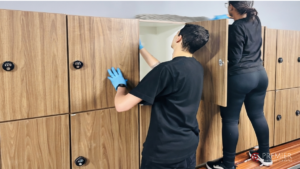
Step 1: Make the Unit Safe Before Anyone Cleans
Electricity, gas and structural checks
Nobody goes in to clean until the power situation is clear. Floodwater and floor-level sockets are a dangerous mix, and ground floor offices often have floor boxes sitting right at the flood line.
Treat every socket, floor box and appliance below the water mark as unsafe until a qualified electrician says otherwise. If your supply itself is affected, ESB Networks is the call, not your own maintenance person.
Check the ceiling and walls too. Water finds voids, and a sagging ceiling tile or bowed partition is a warning, not a cosmetic issue.
Your duty to staff
Here is something most flood guides skip. If you ask your own staff to clean up, you carry a duty of care to them under the Safety, Health and Welfare at Work Act 2005.
In plain terms, you cannot just hand people a mop. Anyone touching silt needs waterproof gloves, boots and eye protection. Nobody with open cuts should be near it, and everyone washes their hands before eating, drinking or smoking.
If you cannot provide that safely, the honest answer is that the clean-up is not a staff job — it is time to bring in a professional commercial cleaning team.
Step 2: Document Everything for Your Insurance Claim
The strongest advice we give clients has nothing to do with cleaning. Photograph first.
Before a single bag of silt leaves the building, walk the unit with your phone. Video the silt lines on the walls. Photograph damaged stock where it sits, the floor coverings, the furniture, the lot. Loss adjusters work from evidence, and evidence disappears fast once cleaning starts.
A few habits that make claims smoother:
- Notify your insurer before disposing of high-value stock or equipment
- Keep a sample of damaged materials, such as a carpet tile offcut, in case proof is requested
- Keep every receipt for emergency cleaning and drying, as adjusters routinely accept professional clean-up as part of a material damage claim
- Log dates and times of everything, including when the water came in if you know it
We cannot tell you what your policy covers. Business interruption and flood cover vary a lot between Irish policies. What we can tell you is that clients who document well argue less with their insurer.
Step 3: Remove Silt the Right Way (and the Mistakes to Avoid)
Work wet, not dry
Silt comes out easiest while it still holds moisture. Shovels, squeegees and wet vacuums shift damp silt cleanly off hard floors.
Wait a few days and it sets like a thin screed, then breaks up into contaminated dust when disturbed. We have seen well-meaning teams sweep dried silt with a yard brush and fill the whole unit with airborne residue. Do not let it get that far.
Rinse low pressure, never blast
It is tempting to bring a pressure washer indoors and blast the lot. Please do not.
High pressure drives contaminated water into wall bases, expansion joints and underfloor voids where it sits and festers. It also throws contamination into the air. Low-pressure rinsing moves residue towards your extraction point without spreading the problem into places you cannot reach.
Clean, then disinfect, in that order
Disinfectant sprayed onto dirt is money wasted. The organic load in silt neutralises it before it can work.
The correct sequence is a detergent wash first, to lift and remove the soiling, then disinfectant on the cleaned surface, left for its full contact time. On our jobs we use eco-friendly products wherever they hold up to the task, and after a flood they usually do, once the sequence is right.
What goes in the skip
Some things do not come back from contaminated water, and pretending otherwise costs more later.
Flood-soaked carpet and underlay, MDF skirting, cardboard stock and porous furniture almost always go. One useful distinction: glued-down carpet tiles sometimes survive a light silting with proper extraction and disinfection, while stretched broadloom carpet over underlay rarely does.
Flood waste should leave with a permitted collector. Any contractor you use should be able to show that their waste route is legitimate.
Step 4: Dry It Out Properly or Mould Moves In
Cleaning removes the contamination you can see. Drying deals with the moisture you cannot.
A ground floor slab, wall bases and plasterboard hold water long after the surfaces look fine. Open windows help, but a proper dry-down needs dehumidifiers and air movers running for days, sometimes weeks. Mould can establish on damp plasterboard remarkably quickly, and once it is inside a wall cavity the fix gets expensive.
We will be straight about scope here, because it builds better outcomes. Premier handles the silt removal, wash-down, disinfection and deep clean. On larger losses, structural drying with moisture meters and monitored equipment is specialist work, and we work alongside drying contractors rather than pretending to replace them.
A cleaning company that claims to do everything after a flood is worth questioning.
The Job We Remember: A Dodder-Side Office Back in Ten Days
Back to that 6am call, because the timeline is what most facilities managers actually want to know.
Day one was safety and paperwork. The electrician isolated the floor boxes, we walked the unit with the client photographing everything, and nothing was moved until the insurer had been notified.
Days two and three were silt removal. Damp silt off 300 square metres of floor, out through the loading door, into covered containers. Carpet tiles were lifted, assessed and, in most areas, binned.
Days four and five were the wash-down. Detergent clean of every hard surface to knee height and above where splashing had reached, then disinfection with proper contact times. Drying equipment ran through the week that followed.
New carpet tiles went in through a flooring contractor, and we came back for the final deep clean and sanitisation before staff returned. Ten days after the water came in, the office reopened.
Not every job runs that cleanly. But the sequence is the same every time, and it is the sequence that gets buildings back.

The Dublin Angle: Rivers, Tides and Repeat Flooding
Dublin floods have a geography, and ground floor units sit at the sharp end of it.
The Liffey quays, the Dodder through Ballsbridge and Donnybrook, the Tolka on the northside and the Camac around Inchicore all have known flood corridors. Add coastal and tidal flooding along the bay, plus surface water flooding anywhere the drains cannot cope with a heavy band of rain, and a lot of commercial ground floors carry some level of risk.
Two things worth doing this week rather than after the next event. Check your building on the OPW flood maps at floodinfo.ie, and pay attention when Met Eireann issues an orange or red rain warning for Dublin. Dublin City Council publishes flooding advice and makes protective arrangements during severe weather, so it is worth knowing what applies to your street before you need it. If you suspect sewer surcharge rather than river water, Uisce Eireann needs to hear about it.
In multi-tenant blocks and older Georgian buildings, loop in your OMC or building management early. Shared walls, shared voids and shared drains mean your silt problem is rarely yours alone.
What Professional Flood Silt Cleaning Involves and Roughly What Affects the Cost
Every flood clean gets priced on the job, and any company quoting a flat rate over the phone is guessing. What actually moves the figure:
- Floor area affected and the depth of silt across it
- Contamination level, since suspected sewage content changes the PPE, products and disposal
- Out-of-hours or emergency response versus a scheduled clean
- Waste volume, because soaked carpet and stock is heavy and disposal is charged by weight
- Access, from loading doors down to a single narrow stairwell
The fastest way to a real number is a site survey, and ours is free. It doubles as a damage walkthrough, which clients often find useful for their insurance conversation. Our founder Catalin puts it this way to every new flood client: photograph it before we touch it, because your insurer was not there this morning and your photos are the only witness.
Book your free assessment through our site survey and quote request page and we will get back to you the same day.
Preventing the Next One
Once a unit has flooded, assume it can flood again, and spend a little to lose a lot less.
Flood barriers or door guards for vulnerable entrances. Stock and electrics raised off the floor, even by 150mm. Gullies and external drains kept clear, especially before autumn, since blocked drainage turns a heavy shower into an internal flood. And an emergency plan with named contacts, including a cleaning contractor who already knows your building.
That last one is where an ongoing contract cleaning relationship quietly earns its keep. The crew that cleans your unit every week does not need a briefing at 6am. They already know where the floor boxes are.
Frequently Asked Questions
Is silt left by floodwater dangerous? Yes. Treat all flood silt as contaminated with bacteria and possible sewage residue. Wear waterproof gloves and boots, keep cuts covered, and disinfect every surface it touched after cleaning.
Can I clean up flood silt myself or do I need professionals? A small patch, with proper PPE, is manageable in-house. For anything room-sized or larger, your duty of care to staff and the contamination risk make a professional commercial cleaning team the safer and usually cheaper choice overall.
What should you not do after a flood in a commercial building? Do not enter before the power is checked, do not throw anything out before photographing it, do not let silt dry in place, and do not pressure-wash indoors.
Does business insurance cover flood clean-up in Ireland? Often yes, under material damage or business interruption cover, but policies vary. Document everything first and confirm with your insurer before disposal. Keep receipts for professional cleaning, as adjusters commonly accept them within a claim.
Should carpet be thrown out after a flood? Usually yes. Carpet and underlay soaked by contaminated water rarely clean back to a safe standard. Glued-down carpet tiles occasionally survive light silting after extraction and disinfection.
How long before we can reopen? Cleaning takes days. Drying takes weeks. A typical ground floor office runs one to two weeks to reoccupation, longer where slabs and walls hold a lot of moisture.
How do we stop mould after a flood? Remove silt fast, disinfect cleaned surfaces, then keep dehumidifiers and air movers running until the structure is dry, not just the surface. Monitor for weeks, not days.
Who should we notify when a business premises floods in Dublin? Your insurer first, then your landlord or OMC, your staff, and Uisce Eireann or Dublin City Council if drains or sewers are involved.
Flooded Ground Floor Unit in Dublin? Talk to Us Today
If you are reading this with silt on your floor, you do not need a brochure, you need a crew and a plan.
Call Premier Contract Cleaning on 086 083 6141, Monday to Friday 7am to 7pm or Saturday 9am to 5pm. We will walk your unit with you on a free site survey, give you an honest scope, and stand over the work with our re-clean guarantee: if your clean is not perfect, we do it again for free.
Vetted, insured, eco-friendly where the job allows, and rated 5.0 stars by Dublin businesses on Google. We have done this before. Let us do it for you.

The fire itself lasted minutes. An electrical fault in a printer corner of a Dublin 2 office, caught early, out before the fire brigade even finished checking the building. The soot was a different story. The next morning the office manager found a grey film on desks two rooms away and black webs hanging in […]
A few winters ago, our phone rang at ten past six in the morning. A facilities manager on the other end, standing outside a ground floor office near the Dodder, trying to keep his voice level. The water had come in overnight and gone back out on its own. What it left behind was worse […]
A property manager at a multi tenant office block near Grand Canal Dock rang us on a Tuesday, standing in the bin store while he talked. The mixed dry recycling for the whole building had been tagged as contaminated two collections running, with a surcharge attached both times, and now the bin was overflowing into […]