

A showroom manager on a main road on Dublin's southside rang us at 7.40am one morning. He had just opened up to find silver tag lines sprayed across his fascia and a crack running through one glass panel. His first instinct, he admitted later, was to send a staff member out with a bottle of […]
What to Do When a Pipe Bursts in Your Dublin Office Overnight
A 6.02am call on a Monday in January. A building manager for a five storey office off Sir John Rogerson's Quay. A heating pipe in the third floor ceiling void had split some time on Sunday night and the water had been running for hours, down through the third floor, through the second floor ceiling tiles, and out across most of the second floor carpet tiles.
He had already turned the water off. He had already rung a plumber. What he asked me was the question everybody asks: can we open at nine. The honest answer that morning was no, and the useful answer was what could be done by Wednesday.
What to do first if a pipe bursts in your office, in order
Do not enter standing water near sockets or floor boxes. Isolate the electrical supply to the affected area at the distribution board, close the internal stop valve and drain the cold taps, then ring an emergency plumber. Photograph everything before anyone mops or moves stock.
- Do not enter standing water if sockets, floor boxes or distribution boards are submerged.
- Isolate the electrical supply to the affected area at the distribution board, not by pulling plugs.
- Turn off the water at the internal stop valve and drain down the cold taps.
- Ring an emergency plumber to find and stop the burst.
- Photograph and video everything before anything is moved or mopped.
- Ring your insurer or broker and open the claim the same morning.
- Get bulk water off the floor as fast as possible, and get drying started.
- Decide, in writing, whether staff come in, and tell them before 7.30am.
The first 60 minutes: what actually matters
Minutes 0 to 10: make it safe before you make it dry
Water and electricity in an office is a different problem to water and electricity in a house, and the difference is where the sockets are.
A modern Dublin office floor distributes power under a raised access floor into floor boxes at desk clusters. That puts your sockets at floor level, which makes them the first thing submerged and the last thing anyone thinks about.
Pulling a plug out of a socket that is standing in water is not isolation. It is a hand going into water beside a live connection. The circuit has to be killed at the distribution board by somebody competent to do it.
- Do not wade in to "just check" how bad it is.
- Do not pull plugs, unplug equipment or move extension leads in standing water.
- Do not enter at all if water has reached a distribution board, a riser or a comms cabinet, until an electrician has isolated and confirmed.
- Do not let a security officer or a cleaner enter to start clearing before that confirmation, however willing they are.
If you cannot get an electrician on the phone, the area stays closed. That is an uncomfortable decision to make at six in the morning and it is the right one every time.
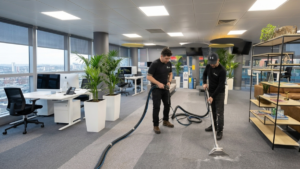
Minutes 10 to 20: stop the water
Find and close the internal stop valve. In a Dublin office it is rarely under a kitchen sink.
Where it usually is:
- The plant room, often beside the incoming main.
- A riser cupboard on the ground floor or in the core.
- The service void behind a tea station.
- An external meter box or a footpath chamber at the boundary.
- A dedicated valve cupboard on each floor in larger buildings.
Then drain down by opening the cold taps on the affected floors, so the pipework empties rather than continuing to feed the split.
Here is the trap that catches people, and it caught the building manager in the story above. If the burst is on a heating circuit rather than a mains supply, closing the mains stop valve will not stop it. A heating system holds a considerable volume of water and it will keep emptying through the split until the system itself is isolated and drained. The mains had already been turned off before we arrived and the water was still coming, because the split was on a heating circuit.
If the pipe is frozen rather than burst, Uisce Éireann's guidance on frozen and burst pipes is worth following exactly. Warm it gently. Never use a blow torch, and never try to thaw it by running the immersion or the central heating, because rapid heating on a frozen section is one of the ways a pipe that was going to survive becomes a pipe that splits.
Minutes 20 to 40: photograph everything before you touch anything
This is the single most valuable ten minutes of the morning, and it is the one almost nobody does, because it feels like standing around while the office floods.
A loss adjuster arriving on day four is looking at a dried, tidied office. They can only assess what you can prove.
Photograph, before anything is moved or mopped:
- Wide shots of every affected room from two corners each.
- The source of the leak, as close as it is safe to get.
- Water depth against a skirting board or a desk leg, with something in shot for scale.
- Ceiling tiles, both the stained ones and the ones that have collapsed.
- Wet stock, files, boxes and paper records in place.
- Wet equipment, with the serial plates readable.
- The carpet and any visible tidemark.
- Anything already showing on walls at low level.
- A slow video walkthrough with the date and time spoken aloud.
Do not tidy for the camera. The mess is the evidence.
Minutes 40 to 60: the four phone calls, in order
| Who to call | Why | What to have ready |
|---|---|---|
| Emergency plumber | Finds and stops the burst. Nothing else can start until this is done | Building address, which floors, whether it is a supply or heating circuit, access arrangements |
| Insurer or broker | Opens the claim and, in many Irish commercial policies, appoints or approves the drying contractor | Policy number, time discovered, what has been affected, that you are mitigating |
| Drying and restoration contractor | Structural drying, moisture readings, the evidence your insurer will want | Floor areas affected, construction type, whether there is a raised access floor |
| Cleaning contractor | Bulk water removal, carpet extraction, the reinstatement clean before staff return | Floor areas, floor finishes, when you need it usable |
The order matters more than people expect. Ring the insurer before you appoint a drying contractor, because some Irish commercial policies give the insurer the right to appoint or approve, and because mitigation costs are usually recoverable but generally only where the insurer was told promptly.
If you are a tenant, there is a fifth call. Ring the managing agent or landlord the same morning, in writing as well as by phone. Never let a discussion about whose insurance it is delay the water coming off the floor.
Catalin's note: The instinct is to start mopping, and I understand it completely. I would ask you to take the photographs first. Ten minutes of video at six in the morning is worth more later than an hour of mopping, and the mopping will not lift bulk water out of a carpet anyway.
Call 01 963 6655 if you need attendance before the working day starts.
Why an overnight burst is worse than a daytime one
A burst that starts at nine in the morning is found in minutes. Somebody hears it, or somebody's feet get wet, and the run time is measured in minutes rather than hours.
A burst that starts at ten on a Sunday night runs for eight or nine hours before anybody sees it. Over a Christmas shutdown, in an empty building, it can run for days.
Three things multiply with time. Total volume, which is simply flow rate times hours. Downward travel, because water finds the ceiling void, then the floor below, then the void below that. And dwell time, which is what starts both the contamination clock and the mould clock.
| Typical run time | Typical spread | Typical outcome | |
|---|---|---|---|
| Daytime burst | Minutes | One room, contained quickly | Extraction and clean, often same day |
| Overnight burst | Eight to twelve hours | Two floors, ceilings down, void wet | Drying required, days out of use |
| Shutdown burst | Unknown, potentially days | Multiple floors, saturated fabric | Strip out, weeks, contents losses |
Then there are the Dublin overnight factors that have nothing to do with plumbing. Alarm and access delays. Key holder response times at four in the morning. Out of hours contractor availability. And the plain fact that nobody is standing in an empty building to hear running water.
A serviced office block in the Sandyford Business District was opened on the 2nd of January after a nine day closure. A flexible tap connector in a second floor tea station had failed at some point during that closure and nobody could say when. That was the whole problem. With no known start time, nothing could be assumed about dwell time, so everything porous in the contact zone had to be treated as if it had been wet for nine days rather than nine hours.
How dirty is the water? The three categories, and why it changes what you can save
Restoration contractors work to a three category system for water contamination, set out in the IICRC S500 standard. That is an international industry standard published by a US based certification body and used widely by restoration contractors as a reference. It is not an Irish or EU regulation, and nobody should present it as one.
- Category 1 is clean water from a sanitary source. A burst supply pipe, a mains feed, a drinking water line.
- Category 2 is significantly contaminated. Washing machine or dishwasher discharge, a heating circuit carrying inhibitor and corrosion products, or category 1 water that has sat and picked up soiling.
- Category 3 is grossly contaminated. A soil stack failure, a macerator, sewage, or floodwater entering from outside.
Now the part nobody explains, which is that the category is not a label. It decides what gets cleaned and what gets discarded.
| Category | Typical office source | Carpet and soft furnishings | Plasterboard |
|---|---|---|---|
| Category 1, caught fast | Burst supply pipe, found within hours | Usually cleanable by extraction | Usually dryable in place |
| Category 2 | Heating circuit, appliance discharge, or category 1 left overnight in a soiled carpet | Carpet tiles often cleanable, underlay usually replaced | Often dryable, monitored closely |
| Category 3 | Soil stack, macerator, external floodwater | Porous materials in the contact zone are removed | Cut out above the wet line |
The practical consequence for an overnight burst is uncomfortable. Clean water that has sat all night in a soiled office carpet is realistically category 2 by the time you find it. It did not start dirty. It got that way while nobody was there.
Categorisation is a judgement made on site by the restoration contractor, not something you should decide alone, and your insurer will expect it to have come from a competent contractor rather than from the facilities manager's opinion.
The 24 to 48 hour rule: why speed is the whole job
The widely used industry planning window is that microbial growth can establish on damp organic materials within roughly 24 to 48 hours at normal indoor temperatures, and that category 1 water degrades toward category 2 over a similar period.
Be clear about what that is. It is a risk based planning window used across the restoration industry, not a guaranteed clock. Temperature, humidity and how much organic material is present all move it, in both directions.
Then translate it into a Dublin office. A heated building at twenty degrees, with a soiled carpet, paper stock and cardboard on the floor, sits at the fast end of that window rather than the slow end.
| Window | What is happening | What it costs you |
|---|---|---|
| Hour 0 to 4 | Water is still spreading and travelling downward | Almost nothing, if you act. This is the cheapest hour of the whole job |
| Hour 4 to 24 | Bulk water removal and drying should be running | Extraction and drying hire |
| Hour 24 to 48 | Microbial risk rising, category degrading, wicking into walls | Underlay, possibly plasterboard |
| Day 3 to 7 | Drying and monitoring, materials decisions being made | Strip out and reinstatement |
| Week 2 onwards | Odour, staining returning, air quality questions | Doing the job a second time |
Everything you do in hours two to twelve is cheaper than everything you do in week two. That is the entire argument for getting somebody on site before the building opens rather than after the adjuster visits.
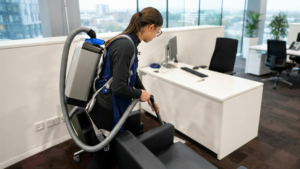
Real site example: a January Monday in Dublin 2
Back to the five storey office off Sir John Rogerson's Quay.
The building manager arrived at 5.50am to a security call, found water coming through the second floor ceiling tiles, and rang me at 6.02. He had already closed the mains and it had not stopped, which told us immediately that we were dealing with a heating circuit rather than a supply pipe. The split was above the third floor ceiling on a horizontal run.
His first good decision was made before we spoke. He did not go onto the second floor. Water was across a raised access floor with floor boxes at every desk cluster, and he waited for the electrician, who isolated the second floor distribution board and confirmed it dead at 7.15.
His second good decision was that nobody mopped. He took a video walkthrough at 6.15am with the date spoken aloud, and that video was the evidence the loss adjuster used four days later, when the floor was dry, tidy and unremarkable.
Our crew were on site at 7.40am with wet pick up machines. The plumber had the circuit isolated and drained by then, so the source was stopped and we were not chasing an ongoing leak.
We lifted the carpet tiles in a grid rather than trying to dry them down, because the void under the raised access floor was holding more water than the floor above it. That is normal and it surprises people every time. Water on a raised access floor does not sit on top of it. It runs through the panel joints and travels along the void, so the wet area below is almost always larger than the wet area you can see.
The drying contractor had air movers and dehumidifiers running by lunchtime, took baseline moisture readings on marked points, and logged them daily.
The second floor was released back into use on the Wednesday afternoon. The third floor took another week, because the plasterboard behind the skirting was still reading wet long after the surface looked and felt dry. We did the reinstatement clean on the Friday night, so the staff who came back on the Monday walked into an office rather than a scene.
| What we did | What we did not do |
|---|---|
| Bulk water removal from hard floors and carpet | Find or repair the burst |
| Lifted and stacked carpet tiles in a planned grid | Isolate or re energise any electrical circuit |
| Hot water extraction on salvageable carpet | Run the structural drying or issue moisture logs |
| Hard floor deep clean and tidemark removal | Strip out plasterboard |
| Reinstatement clean before staff returned | Assess or negotiate the insurance claim |
| Dated before and after photographs and written scope | Lift raised access panels near live floor boxes before isolation |
What can be saved and what usually cannot
Carpet tiles usually survive, broadloom carpet often does not
This is the most searched question on the topic and it deserves a straight answer.
Carpet tiles are modular. They can be lifted individually, dried on both faces in a dry area or off site, and refitted. The bitumen or PVC backing is far less absorbent than a separate underlay, and if a few tiles are lost you replace a few tiles.
Broadloom carpet is the opposite. It is fixed at the perimeter, it holds water in both the pile and the backing, and it sits on an underlay that acts as a sponge and cannot dry in place beneath a fitted carpet.
| Carpet tiles | Broadloom over underlay | |
|---|---|---|
| Can be lifted individually | Yes | No, fixed at perimeter |
| Dries on both faces | Yes | Surface only |
| Underlay beneath | Usually none | Yes, and it is the problem |
| Partial replacement | Straightforward | Difficult and visible |
| Typical outcome, category 1 caught fast | Mostly saved | Often replaced |
Where tiles are saved, commercial carpet and rug cleaning by hot water extraction is what sanitises and deodorises them afterwards, and it is worth doing across the whole affected area rather than only the visibly marked part.
Why the underlay almost always goes
Foam and felt underlay absorbs many times its own weight in water. It sits directly on a cold slab or screed with no airflow underneath it, and it holds moisture against the subfloor long after the carpet surface feels perfectly dry.
Even where the water was category 1, saturated underlay is the classic cause of the odour that comes back in week three, and the classic cause of a stain that reappears after a good clean as moisture wicks back up through the pile.
Signs the underlay has to go:
- The carpet feels dry but the room still smells in the mornings.
- A stain reappears within days of a professional clean.
- Moisture readings at the subfloor stay high while the surface reads dry.
Replacing underlay costs less than doing the whole job twice, which is what the alternative usually turns into.
Plasterboard, skirting and the bottom 300 millimetres
Water wicks upward through plasterboard by capillary action. A wall that looks and feels fine at eye level can be saturated at the base, which is why a dry looking office can still be a wet building.
Check behind the skirting first. It is the fastest honest answer available, and it is where the third floor in our Dublin 2 job gave itself away a week after everything else had dried.
- Gypsum plasterboard loses structural integrity when saturated and does not reliably recover.
- Insulation inside a partition holds water invisibly and vents it slowly back into the room.
- Timber studs and skirting can hold moisture long after the board face reads dry.
A restoration contractor may cut a flood cut line above the wet zone rather than attempt to dry a partition in place. That is a construction decision made on moisture evidence, and it is not a cleaning decision. Nobody should be making it based on how a wall looks.
Raised access floors, floor boxes and the underfloor void
If your office has a raised access floor, this section matters more than any other on this page.
Water does not sit on top of a raised access floor. It runs through the panel joints into the void and travels along it, following the slab falls rather than the room layout. The wet area below is almost always larger than the wet area above, and it is often in a different place.
The void carries power and data, and in some buildings chilled water pipework as well. Floor boxes are the low point, so they fill first, and they are the reason nobody lifts panels with a screwdriver and a torch at six in the morning.
How the void gets dried:
- Electrical isolation confirmed before any panel is lifted.
- Panels lifted in a planned grid, numbered, so the void can be inspected properly and the floor can be put back correctly.
- The void inspected along its length, not just at the visibly wet end.
- Air moved through the void with dehumidification running in the room above.
- Moisture readings taken in the void and at the slab, not only at the panel surface.
One material warning. Panel cores are frequently chipboard. Chipboard swells and delaminates if it stays wet, and a delaminated panel is a trip hazard and a replacement, not a drying problem.
Paper records, electronics and soft furnishings
Wet paper is time critical in a way nothing else on this list is. It needs to be frozen or dried by a document recovery specialist within roughly 48 hours, or the pages block together into an unusable brick. In a Dublin legal or professional services office, that may be the highest value loss on site and the one nobody thinks of until day three.
Do not power on any wet equipment, and do not assume a machine that starts is undamaged. Corrosion on boards takes weeks to cause a failure, which is why the serial plate photographs matter.
Task chairs, breakout seating and acoustic panels can often be extracted and cleaned where the water was clean and the response was fast. Where they have wicked water up from a saturated floor and sat in it overnight, the honest assessment is usually less optimistic, and that assessment should be made before somebody pays to clean something that is going to be replaced anyway.
How a flooded office is actually dried out
You will be asked to authorise drying equipment, so it is worth knowing what you are authorising.
Air movers do not dry anything on their own. They move air across wet surfaces and accelerate evaporation, which moves water out of the material and into the air. Dehumidifiers then take that water back out of the air. Without them, air movers just relocate the moisture into another part of your building, very often the ceiling void above.
| Equipment | What it actually does | Who runs it |
|---|---|---|
| Wet pick up machine, industrial wet vacuum | Removes bulk water from hard floors and carpet | Cleaning contractor |
| Air mover | Accelerates evaporation from wet surfaces | Drying contractor |
| Refrigerant dehumidifier | Condenses moisture out of the air, effective in warmer conditions | Drying contractor |
| Desiccant dehumidifier | Adsorbs moisture, works at lower temperatures and lower humidity | Drying contractor |
| Moisture meter, pin and pinless | Measures moisture content in materials | Drying contractor |
| Hygrometer | Measures relative humidity and temperature in the space | Drying contractor |
| Thermal imaging camera | Shows surface temperature difference caused by evaporative cooling | Drying contractor |
Two things about that last row, because thermal imaging gets oversold. It does not show water. It shows temperature difference, and evaporating water is cooler, which is why wet areas often appear on a thermal image. Every thermal finding has to be confirmed with a meter before anyone acts on it.
Drying is measured, not guessed. A competent contractor takes daily readings on the same marked points and logs them, and the target is a return to a dry standard consistent with unaffected areas of the same building, not a number pulled from a table.
Where we stop. Premier removes bulk water, extracts carpet and upholstery, deep cleans hard floors and carries out the reinstatement clean. We do not carry out structural drying, we do not issue drying certificates and we do not take the moisture readings your insurer will rely on. That is the restoration contractor's job, and your insurer will expect those logs to come from them.
Insurance, loss adjusters and the evidence you need in Ireland
Escape of water is not the same as flood
This distinction decides whether claims are paid.
A burst pipe inside the building is normally an escape of water claim under a commercial property policy. Flood generally means water entering the building from outside, and it is frequently a separate peril with different terms, different excesses and sometimes different availability.
Use the words escape of water when you ring. It routes the claim correctly from the first sentence and saves a conversation later.
Loss adjuster or loss assessor, and who works for whom
In Ireland these are two different roles and people confuse them constantly.
A loss adjuster is appointed by, and acts for, the insurer. Their job is to assess the claim on the insurer's behalf.
A loss assessor is engaged by, and acts for, the policyholder. They charge a fee, usually a percentage of the settlement.
Neither is your enemy and neither is your advocate by default, so know which one is standing in your office. Insurance intermediaries in Ireland are regulated by the Central Bank of Ireland, and Insurance Ireland is the industry representative body rather than a regulator.
What the adjuster will ask you for
- Dated photographs and video from before the clean up started.
- The plumber's report on cause.
- A written scope from the drying contractor, with the moisture logs.
- A written scope and invoice from the cleaning contractor.
- An inventory of damaged contents, with serial numbers where relevant.
- Evidence of mitigation, meaning what you did and when to limit the damage.
- If business interruption is being claimed, evidence of lost trading or displaced staff days.
Notice how much of that has to be captured on the first morning rather than assembled later.
Trace and access, mitigation and business interruption
Three terms worth knowing before somebody uses them at you.
Trace and access covers the cost of opening up walls, floors and ceilings to find the leak, and making good afterwards. It is frequently overlooked and it can be a substantial part of the bill on a concealed pipe.
Mitigation is your duty to limit the damage. It is the reason prompt extraction and drying is usually recoverable rather than a cost you carry, and it is also why "we did nothing until the adjuster came" is an expensive position.
Business interruption covers loss of income and additional working costs while the office is out of use. It is the reason to log every displaced staff day from the first morning, in a spreadsheet, with dates.
Landlord or tenant, who pays in a Dublin multi tenant office
The usual split, in principle: building fabric and common services sit with the landlord's insurance, while tenant fit out, contents and business interruption sit with the tenant's.
In practice the lease decides it, and leases vary more than people expect. The service charge route often carries part of it, and a managing agent will normally coordinate the building claim.
Whatever the position turns out to be, do not let an argument about the boundary delay mitigation. The water does not wait for a lease interpretation, and both insurers will ask why nothing was done.
When can staff come back in?
The office is not ready because it looks dry. It is ready when all of the following are true.
- The source has been repaired and confirmed.
- Electrical circuits in the affected zone have been checked and re energised by a competent electrician.
- Moisture readings in affected materials have returned to a dry standard consistent with unaffected areas of the same building.
- There is no residual odour.
- Floors are clean, dry and slip safe.
- Drying equipment has either been removed, or is confined to a zone barriered off from occupied space.
Underneath that sits an employer duty. Under the Safety, Health and Welfare at Work Act and the General Application Regulations, S.I. No. 299 of 2007, an employer must provide a safe place of work. That covers wet and slippery floors, trailing cables from drying equipment, noise from air movers running all day beside desks, and any area with compromised electrics. The Health and Safety Authority is the Irish regulator here, and wet floors and slip risk is a live duty during a drying period rather than an abstract one.
There is a middle option that people forget under pressure, and it is usually the right one.
An office manager at a professional services firm in Dublin 4 had to answer the reoccupation question by half seven on the morning after a burst. She could not say the whole floor was safe and she did not want to close the business for a day she might not need to lose. So she barriered the wet zone properly, moved the two affected teams into a meeting suite on the floor above, told everyone else to come in as normal, and kept the business trading. The drying ran for four days behind a barrier and nobody lost a working day.
Partial reoccupation is not a compromise. In most office floods it is the correct answer.
What Premier does, and where somebody else takes over
| This is our job | This is not our job |
|---|---|
| Bulk water removal from hard floors and carpet | Finding and repairing the burst |
| Hot water extraction on carpet and rugs | Isolating or re energising electrical circuits |
| Upholstery and soft furnishing cleaning | Structural drying and drying certificates |
| Hard floor deep cleaning and tidemark removal | Moisture readings used as claim evidence |
| Disinfection where the source was contaminated | Stripping out saturated plasterboard |
| Full reinstatement clean before staff return | Lifting and reinstating raised access panels near live services |
| Dated before and after photographs and written scope | Assessing or negotiating the insurance claim |
A facilities manager asked me this directly once, and it is a fair question: you are a cleaning company, why am I ringing you about a flood?
Because three of the things that have to happen in the first six hours are cleaning work. Getting bulk water off a carpet is a wet pick up machine, not a mop. Extracting and sanitising that carpet afterwards is carpet cleaning. And the reinstatement clean, once the plumber, the electrician and the drying contractor have all walked through the office for a week, is the thing that decides what your staff actually see on Monday morning.
There is a practical argument too. Your existing cleaning contractor already holds keys, already knows the alarm code, already has a supervisor twenty minutes away, and already knows which floors matter. That is why we can be on a floor at 7.40am, and it is why the commercial cleaning services in Dublin contract is worth more on a bad morning than a number you have never rung before.
Our office cleaning in Dublin teams handle the reinstatement clean out of hours so nobody loses a working day to it, and if the clean is not perfect we come back and do it again, for free.
Preventing the next one: the Dublin winter checklist
Irish bursts do not cluster because of sustained deep cold. They cluster because of short sharp cold snaps followed by a rapid thaw, and the burst is usually discovered on the thaw rather than on the freeze. The pipe splits while frozen and does nothing. It starts running when it warms.
Which means a Met Éireann low temperature or ice warning is not weather news. Treat it as an operational trigger.
Before the Christmas shutdown
- Leave the heating on a low frost setting rather than off entirely.
- Know and label the internal stop valve and the heating isolation valve, and check both actually turn.
- Lag exposed pipework in roof voids, plant rooms, car parks and unheated stores.
- Isolate water to unoccupied floors, tea stations and washrooms that will not be used.
- Confirm the key holder list and out of hours numbers before people go on leave.
- Arrange at least one physical walk round of the building during the shutdown.
- Move paper records and stock off the floor and away from external walls.
- Check that floor boxes and comms cabinets are not sitting in a known low spot.
- Confirm your alarm monitoring covers any flood or leak detection you have installed.
- Save the numbers: plumber, electrician, broker, drying contractor, cleaning contractor.
All year round
- Leak detection on risers and plant rooms.
- An annual check that every stop valve turns, not just that it exists.
- Planned maintenance on ageing pipework and flexible tap connectors, which fail more often than pipe does.
- An incident sheet on the plant room wall with the call order on it.
- A named deputy for when the facilities manager is on leave, which is precisely when this happens.
Catalin's note: The worst jobs we attend are found on the thaw, not on the freeze. A building that is closed for nine days needs somebody to walk it at least once, and it takes twenty minutes. If you want, walk it with us before the shutdown and we will note where every isolation valve is, because six in the morning is a bad time to be looking for one.
Frequently asked questions
What is the very first thing to do if a pipe bursts in the office? Make it electrically safe before anything else. Do not enter standing water near sockets, floor boxes or a distribution board, and isolate the affected circuits at the board rather than by pulling plugs. Only then close the internal stop valve and ring an emergency plumber.
Is it safe to walk into a flooded office? Not until the electrics are isolated. Office power is usually distributed under a raised access floor into floor boxes at desk level, so the sockets are the first things submerged. If water has reached a distribution board, riser or comms cabinet, nobody enters until an electrician confirms it is dead.
Do I call a plumber or my insurer first? Plumber first, to stop the water, then the insurer or broker the same morning. Many Irish commercial policies allow the insurer to appoint or approve the drying contractor, and mitigation costs are generally recoverable only where the insurer was notified promptly.
How quickly does mould start after an office flood? The widely used industry planning window is roughly 24 to 48 hours for microbial growth to establish on damp organic materials at normal indoor temperatures. It is a risk based window rather than a fixed clock, and a heated office with a soiled carpet sits at the faster end of it.
Can office carpet tiles be saved after a flood? Often yes, where the water was clean and the response was fast. Tiles can be lifted individually, dried on both faces and refitted, then extracted and sanitised. Broadloom carpet fitted over an underlay is far less likely to survive, because the underlay cannot dry in place.
Does the underlay always have to be replaced? Not always, but usually. Foam and felt underlay absorbs many times its weight, sits on a cold slab with no airflow beneath it, and holds moisture long after the surface feels dry. Saturated underlay is the usual cause of odour and staining returning weeks later.
How long does it take to dry out a flooded office? It depends on the materials, not the calendar. A carpet tile floor after a fast category 1 response can be back in use in days. Saturated plasterboard, insulated partitions and an underfloor void take considerably longer, and the answer comes from moisture readings rather than from an estimate.
Can staff work while drying equipment is running? Sometimes, with the zone properly barriered. The employer duty to provide a safe place of work covers slip risk, trailing cables and noise from air movers. Partial reoccupation, with affected teams relocated and the wet area barriered off, is usually the right answer.
Does commercial insurance in Ireland cover a burst pipe? A burst pipe inside a building is normally covered as escape of water under a commercial property policy. Flood, meaning water entering from outside, is often a separate peril with different terms. Use the words escape of water when you ring, and check your own policy wording.
What is the difference between a loss adjuster and a loss assessor in Ireland? A loss adjuster is appointed by and acts for the insurer. A loss assessor is engaged by and acts for the policyholder, and charges a fee, usually a percentage of the settlement. Insurance intermediaries in Ireland are regulated by the Central Bank of Ireland.
Who is responsible for a burst pipe, the landlord or the tenant? The lease decides it. Typically building fabric and common services sit with the landlord's insurance and tenant fit out, contents and business interruption sit with the tenant's. Never let an argument about the boundary delay getting water off the floor.
Why do office pipes burst over the Christmas shutdown? Because the building sits unheated and unoccupied for up to two weeks, so a cold snap freezes pipework that would normally be protected by background heat. The split then runs undetected on the thaw, sometimes for days, which is why shutdown bursts are the most damaging kind.
Emergency cleaning and post flood reinstatement in Dublin
If you have water on the floor right now, ring 01 963 6655. We attend out of hours, overnight, at weekends and early in the morning, across Dublin 1 and the IFSC, Dublin 2 and the Docklands, Dublin 4 and Ballsbridge, Sandyford, Leopardstown, Blanchardstown, Citywest, Blackrock, Bray, Leixlip and Maynooth.
What we will do on that call: tell you honestly whether the first job is ours or somebody else's, give you a realistic time we can have machines on your floor, and start the written record you are going to need for the claim.
- Bulk water removal, carpet and upholstery extraction, hard floor deep cleaning.
- Full reinstatement clean before staff return, scheduled out of hours.
- Dated before and after photographs, a written scope and a documented sign off.
If nothing has happened yet and you are reading this in November, the more useful call is the free site survey. We walk the building with you, note where the isolation valves are, and agree what happens if this occurs during the shutdown. It takes half an hour and it is the cheapest thing on this page.
Email enquiries@premiercontractcleaning.ie or talk to us about an emergency callout. You can also read more about our washroom cleaning in Dublin or see what our clients say. If your clean is not perfect, we will do it again, for free.
The second floor off Sir John Rogerson's Quay was back in use on the Wednesday.

The fire itself lasted minutes. An electrical fault in a printer corner of a Dublin 2 office, caught early, out before the fire brigade even finished checking the building. The soot was a different story. The next morning the office manager found a grey film on desks two rooms away and black webs hanging in […]
A few winters ago, our phone rang at ten past six in the morning. A facilities manager on the other end, standing outside a ground floor office near the Dodder, trying to keep his voice level. The water had come in overnight and gone back out on its own. What it left behind was worse […]
A property manager at a multi tenant office block near Grand Canal Dock rang us on a Tuesday, standing in the bin store while he talked. The mixed dry recycling for the whole building had been tagged as contaminated two collections running, with a surcharge attached both times, and now the bin was overflowing into […]