

A showroom manager on a main road on Dublin's southside rang us at 7.40am one morning. He had just opened up to find silver tag lines sprayed across his fascia and a crack running through one glass panel. His first instinct, he admitted later, was to send a staff member out with a bottle of […]
What to Do When a Drain Backs Up in a Commercial Kitchen
A Thursday in December, a basement kitchen serving a city centre hotel off the north quays. The night manager rang me at 20:40. The two floor gullies beside the pot wash had started backing up, the kitchen porter had been mopping for twenty minutes, and the pass was still sending food out.
When we arrived there was grey water standing about 15mm deep across the pot wash bay, running under the ambient shelving. The grease trap lid had not been lifted in months.
The short answer: stop production first, clear the drain second
A commercial kitchen drain backing up is a food safety incident with a plumbing component, not the other way round. A drainage engineer clears the blockage. A specialist clean makes the area food safe again. Both have to happen before you reopen.
- Stop food preparation in the affected area and move staff out.
- Contain the spread and protect food, packaging and equipment.
- Isolate the source: stop using sinks, dishwashers and anything discharging to that run.
- Call a drainage contractor to locate and clear the blockage.
- Deep clean and disinfect all affected surfaces to a food safe standard.
- Record it in your food safety management system before you reopen.
If you take one thing from this page, take the order. Almost every kitchen that loses a full trading day gets steps four and five the wrong way round, or skips five entirely.
Why this is a food safety incident and not just a plumbing problem
What is actually in the water coming up through your gully
A commercial kitchen drainage run carries food waste, fat, oil and grease, and wash water. On most Irish city centre sites it joins the same foul system as the toilets, because older Dublin building stock is largely on combined drainage.
So when it surcharges, what arrives on your floor is foul water, not dirty washing up water. Published foodservice guidance identifies the realistic hazards in a foul water escape as including E. coli, norovirus, hepatitis A, Shigella, Giardia and Cryptosporidium.
That is the whole reason the response has to be procedural. Nobody standing in the pot wash bay at 20:40 can tell by looking which of those is present.
Why the law does not let you mop it and carry on
Every food business in Ireland must operate a food safety management system based on HACCP principles. That is a legal requirement, given effect through the European Communities (Hygiene of Foodstuffs) Regulations 2006, S.I. No. 369 of 2006, which transposes Regulation (EC) No 852/2004.
Cleaning, maintenance and waste control sit underneath that as prerequisite programmes. They are not optional extras, they are the foundation the HACCP plan rests on.
A food area contaminated with foul water is precisely the kind of hazard your system exists to control. The failure an Environmental Health Officer will look at is not the blockage. Blockages happen. The failure is continuing to plate food across a contaminated floor.
What an Environmental Health Officer can actually do
Environmental Health Officers from the HSE Environmental Health Service act as authorised officers under the Food Safety Authority of Ireland Act 1998 and the EU (Official Controls in Relation to Food Legislation) Regulations 2020, S.I. No. 79 of 2020.
There are four instruments, and it is worth knowing which is which before you meet one.
| Instrument | Who serves it | Trigger | Publication |
|---|---|---|---|
| Improvement Notice | Authorised officer | A premises or practice that will or is likely to pose a risk to public health if it persists | Not published on the FSAI website |
| Improvement Order | District Court | Non compliance with an Improvement Notice | Listed in FSAI enforcement reports |
| Closure Order | Authorised officer, or District Court | Grave and immediate danger to public health. Can apply to all or part of a premises, or to some activities | Listed for three months from the date the order is lifted |
| Prohibition Order | Authorised officer | Relates to a particular consignment, class, batch or item of food | Listed for one month |
To be clear, a drain backing up does not automatically produce a closure order. It very much depends on what you did next.
What does show up repeatedly in FSAI enforcement reports is basic hygiene failure: filthy floors under equipment, food debris built up in hard to reach areas, dirt where nobody has cleaned in months. A kitchen that has had foul water across the floor and has not been properly decontaminated is exactly that picture, photographed.
For scale, FSAI reported 127 enforcement orders served on food businesses in 2025, made up of 102 closure orders, 23 prohibition orders and 2 improvement orders. Most of those were not drainage incidents. Some of them started as one.
How to tell what is actually blocked
Before you ring anyone, work out roughly where the problem is. It changes who you call and, often, who pays.
The anatomy of a commercial kitchen drainage run
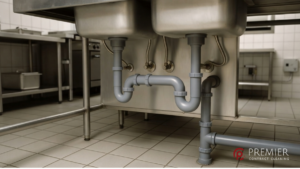
Water leaves your kitchen through a sequence, and the blockage is somewhere along it:
- Fixture branches. Sink, pot wash and dishwasher outlets, each with its own trap.
- Floor gullies and channel drains, usually with a removable basket to catch solids.
- The grease trap or grease removal unit, where fat is supposed to be intercepted.
- The private lateral, running from your building to the boundary. Yours to maintain.
- The shared or public sewer, maintained by Uisce Eireann.
Then there is the rule that explains most of what you are seeing. A backup surfaces at the lowest opening on the run.
That is why a basement kitchen floods while the ground floor bar stays perfectly dry, and it is why the blockage may not be in your kitchen at all. Being the lowest point does not make you the cause.
Symptom to cause table
| What you are seeing | Most likely cause | Who to call first | Does the kitchen stop |
|---|---|---|---|
| One sink drains slowly, others fine | Local branch or trap blockage | In house maintenance | Not necessarily |
| Pot wash sink and nearest floor gully both back up | Blockage downstream of both, often the grease trap or the branch after it | Drainage contractor | Yes, for that area |
| Water rises through gullies when the dishwasher discharges | Blocked lateral or surcharged main run | Drainage contractor | Yes |
| Grease trap lid weeping or overflowing, strong rancid odour | Trap full or unserviced | Grease trap servicing contractor | Yes, for that area |
| Toilets in the building also gurgling or backing up | Blockage on the shared foul lateral or the public sewer | Drainage contractor and Uisce Eireann | Yes, whole premises |
| Sewer odour, no water, one gully only | Dried out trap seal on a little used gully | In house, refill the seal | No |
| Backups recurring after every busy weekend | Chronic grease loading in the line | Drainage contractor plus a grease management review | Not immediately, but plan |
Two things that tell you it is grease and not an object
First, it builds gradually. A grease blockage takes weeks to close a bore, so the warning signs are slow drainage and the occasional gurgle long before anything reaches the floor.
Second, it comes back. Clear an object and it is gone. Clear grease without changing what goes down the drain and you will see it again within weeks.
The mechanism is simple. Fat, oil and grease leaves the kitchen warm and liquid, cools as it travels, and sets on the pipe wall. Each service adds another layer.
A staff canteen in a Sandyford business park showed us this one perfectly. For three weeks the only symptom was one slow pot wash sink that everyone had learned to live with. On a Monday morning the whole bay flooded before nine.
What to do in the first ten minutes
- Stop food preparation and service in the affected area. Move open food away first, then people. In that order.
- Stop discharging water into that run. Turn the dishwasher off mid cycle if you have to. Stop the pot wash, the prep sinks and anything else draining to it.
- Cordon the area. Wet floor signage is not enough here. Physically block the route so nobody walks foul water into the dry side or out to the pass.
- Contain the spread with an absorbent barrier or a squeegee ridge, working from the clean side towards the gully. Never the other way.
- Protect and quarantine. Anything porous, unwrapped or splashed goes into a segregated bin now, not later, and gets marked so nobody puts it back.
- Photograph everything. Wide shot and close up, timestamped. This becomes your evidence and your insurance record, and you will not be able to recreate it tomorrow.
- Call a drainage contractor. Tell them it is a commercial kitchen on a foul run, tell them whether it is a basement, and ask whether they have CCTV survey capability rather than just a jetter.
- Call your cleaning contractor at the same time. Not afterwards. The decontamination has to be booked while the engineer is still travelling if you want to trade tomorrow.
Do not mop it. Do not pour boiling water and degreaser down a surcharged gully. Do not use domestic remedies like bicarbonate of soda and vinegar, which are all over the internet and will not touch congealed fat in a 100mm branch. And do not send a kitchen porter down with an auger while the pass is still plating food.
By the time we reached that hotel basement, the porter had been mopping for twenty minutes and had been pushing the water back into the gully it was coming out of. That is the single most common thing we see, and it is nobody's fault. It is just what a mess looks like it needs.
What happens to the food
| Item type | Decision | Why |
|---|---|---|
| Open or unwrapped food in the affected area | Discard | Direct or aerosol contact with foul water cannot be ruled out |
| Food on low shelving within splash range | Discard | Splash range is always wider than it looks |
| Food contact packaging and single use items | Discard | Porous, and they touch food next |
| Ice in a machine draining to the affected run | Discard, then clean and disinfect the machine | The drain is the route in |
| Food in sealed rigid containers, undamaged | Retain, wash and disinfect the exterior | The seal did its job |
| Anything you are unsure about | Discard | An unresolvable doubt is a decision |
Record the discard. What went, roughly how much, who decided, and on what basis. That entry in your food safety management system is what turns a judgment call into a documented control, and it is the first thing anyone will ask to see.
Clearing the blockage: what a drainage contractor will actually do
This part is not our work. We do not clear drains and we will tell you that on the phone. But you should still know what good looks like, because you are the one signing it off.
- CCTV drain survey to locate the blockage and see what kind it is. Guessing costs more than surveying.
- High pressure water jetting for soft grease blockages, which is most of them in a kitchen.
- Mechanical rodding or an auger for hard obstructions, which is engineer work with the right equipment, not a job for your porter.
- A post clearance CCTV run to confirm the bore is actually open rather than simply flowing again.
One thing worth knowing about older Dublin stock. Root ingress through cracked joints on external runs is common on Georgian and Victorian buildings, and it needs a repair rather than a clear. If the engineer finds roots, you have a capital job, not a maintenance job, and no amount of jetting will settle it.
Catalin's note: Ask the engineer for the after footage, not just the before. Plenty of jobs get signed off the moment water starts moving. If the bore is still half closed with fat, you will be doing this again in three weeks, usually on a Saturday.
The part nobody tells you about: decontaminating a food area after foul water
Clearing water is not cleaning. Cleaning is not disinfection. Those are three separate jobs, and most kitchens do the first one and stop.
Why you cannot disinfect a dirty floor
Organic soil neutralises disinfectant. Grease, food debris and foul water residue consume the active ingredient before it ever reaches the bacteria on the tile.
That is not a slow failure, it is an immediate one. It is also exactly why the food industry standard for disinfectants tests products under dirty conditions as well as clean, because the manufacturers know what real floors look like.
So the sequence is always the same: remove, clean, rinse, then disinfect with a stated contact time. Skip the rinse and you have effectively skipped the disinfection.
The two stage clean and disinfect method
- PPE and access control. Gloves, eye protection, disposable coveralls, dedicated footwear, and colour coded equipment that never goes back to the food side.
- Extract standing water with a wet vacuum. Never push it towards clean areas. This is where a squeegee does more harm than good.
- Remove and bag all contaminated absorbent materials and single use items as segregated waste, at the point of use.
- Strip the area. Move mobile equipment, lift bench skirts, open plinths, pull racking away from walls. What you cannot reach, you cannot clean.
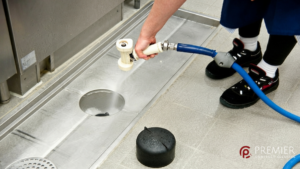
- Stage one clean. Alkaline degreaser at the correct dilution and temperature, mechanically agitated with a rotary machine or deck brush on quarry tile and safety vinyl. Grout lines, coving, wall to floor junctions, plinths, equipment legs, castors and the gully surround all included.
- Rinse thoroughly and extract again. Disinfectant applied over residual detergent and soil will not perform, no matter what it cost.
- Stage two disinfection. Apply a disinfectant meeting EN 1276 at the manufacturer's stated dilution, and leave the full contact time.
- Deal with the gullies and channel drains themselves. Baskets out, scrubbed, disinfected, trap seals refilled.
- Final rinse where the product requires it, dry the floor fully, reset the room.
On step seven, it is worth understanding what EN 1276 actually means, because it is the number you should be asking your contractor for. It is a quantitative suspension test for bactericidal activity in food, industrial, domestic and institutional areas. It requires a 5 log reduction, meaning 99.999 per cent of the test bacteria, within a 5 minute contact time, tested against E. coli, Enterococcus hirae, Pseudomonas aeruginosa and Staphylococcus aureus, under both clean and dirty conditions.
A product that cannot show you that data at the dilution you are using is not a food area disinfectant, whatever the label says on the front.
The bits people miss
- Under bench voids and the back of plinths.
- Castors and equipment feet, where water sits longest.
- The underside of mobile racking.
- Wall to floor coving, particularly where the seal has lifted.
- The gully basket itself, which is often cleaner than the recess it sits in.
- Mop heads and squeegees used during the incident. Bin them, do not launder them.
- The porter's footwear.
- Any adjacent staff washroom or changing area walked through during the incident. That is usually where our washroom cleaning in Dublin team picks up the trail.
- Odour once the floor is dry, which tells you whether organic material is still present.
Getting it signed off
Here is exactly what we hand over: dated before and after photographs, the areas covered, the products used with dilution and contact time, the waste removed, the operatives on site, and the time we released the area back to the food business.
Our staff are health and safety trained, and we do not carry out drainage works. Both of those belong on the record too, because scope clarity is part of the evidence.
Catalin's note: The photographs are the part clients undervalue on the night and ring us for three weeks later, when somebody official asks what exactly was done. That pack is the difference between saying you cleaned it and showing what you cleaned, with what, and when.
A real site example: a basement hotel kitchen in Dublin city centre
Back to that Thursday in December. Basement kitchen, city centre hotel, roughly 130 covers still to go out.
What they had already tried was mopping the water into the gully it was coming out of, and a bottle of drain unblocker from the cash and carry. Neither did anything, and the second one was money into a surcharged pipe.
What we found: two gullies surcharged, water tracking under the ambient shelving where nobody had looked, a grease trap that had not been lifted or serviced in months, and a dishwasher whose discharge pushed the water level up visibly on every cycle.
Then came the decision that saved the next day. The kitchen stopped. The hotel switched the restaurant to a limited cold menu prepared in a separate first floor area for the rest of the night. They lost the à la carte service and a fair amount of goodwill with a few tables.
The engineer's finding was a soft grease blockage on the branch downstream of the trap. Jetted, then confirmed clear on CCTV, which is the part I always ask for.
The night, in order:
- 20:40, the call and the decision to stop production.
- 21:15, drainage contractor on site.
- 22:50, blockage cleared and confirmed on camera.
- 23:30, our team in.
- 05:40, area released, photo pack issued.
We stripped the floor, degreased, rinsed, extracted and disinfected, pulled and cleaned both gullies, and removed the contaminated materials as segregated waste. The kitchen opened for breakfast service.
Afterwards, two things went into the contract: a grease trap servicing schedule with a named responsible contractor, and a monthly gully and channel drain deep clean written into the specification rather than left to whoever remembered.
The honest caveat, and I would rather say it than let this read as a rescue story. That night went well because the manager stopped service at 20:40 instead of trying to finish the covers and ringing us at 22:00. Ninety minutes was the whole margin.
When to sort it in house and when to call a professional
| Handle in house | Stop and call |
|---|---|
| Single slow sink, no odour, no overflow | Any water surfacing on the floor |
| Dry trap seal odour on one gully, no water | Any water surfacing while food is being prepared |
| Gully basket full of food solids, cleared before service with proper PPE | Grease trap at or near capacity |
| Sink strainers emptied and cleaned routinely | Toilets in the building affected as well |
| Logging a slow drain in the maintenance record | A blockage recurring more than twice in a quarter |
| Refilling a trap seal on a little used gully | Any foul water contact with a food preparation surface |
The question we get asked every single time is whether the dry side of the kitchen can keep working while the wet side is dealt with.
Usually the honest answer is no. The floor is shared, the foot traffic is shared, the air is shared, and the drainage run is shared. If your staff walk from the pot wash to the pass, the separation exists on a plan and nowhere else. A genuinely separate prep area with its own access and its own drainage is a different matter, and that is what the hotel used.
To be plain about where we sit: Premier does not clear blocked drains. We decontaminate and deep clean the kitchen afterwards, and we maintain it so the loading that caused it stops building. If you ring us with a blockage we will tell you to call a drainage contractor first, and then we will book the overnight.
How to stop it happening again
Fat, oil and grease is the cause of most of these calls
Fat leaves your kitchen as a warm liquid and arrives further down the run as a cold solid. Every service adds a layer to the pipe wall until the bore closes. That is the entire mechanism, and everything below is about interrupting it.
Your obligations in Dublin: FOG, grease traps and trade effluent
A trade effluent discharge to sewer licence, issued under Section 16 of the Local Government (Water Pollution) Act 1977 as amended, is a legal requirement where a business discharges trade effluent to a public sewer.
Uisce Eireann's guidance for food service establishments is direct on the rest. A food service establishment should already have a grease trap or grease removal unit fitted. The equipment must be kept fully serviced in accordance with the manufacturer's recommendations. It must be maintained properly by kitchen staff or authorised contractors, with maintenance details recorded. And records should be kept of all maintenance and servicing, and of how used cooking oil is recycled.
Then the part that concentrates the mind. Uisce Eireann states that if FOG discharged from your premises causes blockages and flooding, you may be liable for covering the costs, including specialist machinery, specialist personnel, loss of stock and premises clean up.
Dublin City Council runs a fats, oils and grease programme for the city, with responsibility for the programme having transferred to Irish Water, now Uisce Eireann, from 1 January 2014. Worth knowing which body you are dealing with before you ring the wrong one.
On equipment, the reference to ask your installer about is I.S. EN 1825-2:2002, the grease separator standard covering selection of nominal size, installation, operation and maintenance, adopted in Ireland by NSAI.
Your five obligations, in short:
- Hold a trade effluent discharge licence where one is required for your discharge.
- Have a correctly sized grease trap or grease removal unit fitted.
- Service it in line with the manufacturer's recommendations.
- Keep the maintenance and servicing records.
- Keep the used cooking oil collection records.
One point of honesty on frequency. There is no single legally mandated servicing interval, and anyone quoting you one as law is guessing. The interval is driven by the manufacturer's recommendations, the trap size and your actual fat loading. The practical test is whether the trap is being emptied comfortably before it approaches capacity, and if it is not, the interval is wrong regardless of what the schedule says.
Kitchen floor controls that actually reduce blockages
- Dry wipe pans and trays into the food waste bin before they reach the pot wash.
- Scrape plates over a solid waste bin, never into a sink.
- Fit gully baskets and sink strainers, and actually empty them every service.
- Collect used cooking oil for recycling and keep the collection dockets.
- Never pour hot fat or fryer oil down any drain, including the outside yard gully.
- Do not rely on hot water and detergent to flush it through. That just moves liquefied fat further down the line to set where you cannot reach it.
- Schedule the grease trap service against covers and menu type, not the calendar alone.
- Put a gully and channel drain deep clean on the cleaning rota with a named frequency.
- Log every slow drain in the maintenance record so the pattern is visible before the flood.
- Include the drainage points in the kitchen deep clean specification, in writing.
Number five is not theoretical. A restaurant in Dublin 2 had a new starter pouring fryer oil into the yard gully for a fortnight, purely because nobody had shown him where the collection drum lived. Prevention here is mostly training, not equipment.
What a scheduled kitchen deep clean should include
A daily kitchen close down is not a deep clean, and the gap between them is where blockages grow.
A proper scheduled deep clean covers floors and grout lines, coving and wall to floor junctions, under and behind equipment, plinths and equipment castors, gully surrounds and the baskets themselves, and finishes with a signed record of what was done.
That last item matters more than it sounds. If the drainage points are not named in the specification, they are not being cleaned, whatever anyone assumes. Our scheduled kitchen and back of house deep cleaning writes them in explicitly, and buildings with a staff canteen usually fold it into their office cleaning contract rather than running it separately.
Cost, timing and compliance: what to expect
Timing
A typical incident night runs like this: containment inside the first hour, drainage attendance the same evening on an emergency call, decontamination as an overnight shift, and the area released before the morning delivery.
A small pot wash bay is a single overnight shift. A full basement kitchen needing an equipment strip out can be two.
What drives the cost
| Variable | Effect |
|---|---|
| Floor area actually affected | The main driver, and it is usually larger than the visible wet patch |
| Floor type and grout condition | Worn grout on quarry tile holds soil and takes longer |
| How far the water travelled | Under shelving and into voids adds hours |
| How much equipment has to be moved | Strip out is often half the shift |
| Whether contaminated stock is removed as waste | Segregated waste handling and disposal |
| Out of hours or overnight shift | Premium rate, but you trade the next day |
| Whether a maintenance schedule follows | Changes the whole economics over a year |
We quote after a free site survey, and emergency work is quoted before it starts, not after it finishes.
The compliance cost people forget
A lost trading night is visible and painful and over. What is less visible is what follows a badly handled incident.
A repeat incident in six weeks, because nothing upstream changed. A listing in an FSAI enforcement report that stays published for three months after the order is lifted, and remains searchable long after that. And the Uisce Eireann FOG liability point, where the food business can end up carrying the blockage and clean up costs directly.
Set against that, one stopped service looks like the cheap option, because it usually is.
Frequently asked questions
Do I have to close my kitchen if a drain backs up? You must stop food preparation in the affected area immediately. Whether the whole kitchen closes depends on whether the contamination, foot traffic and drainage are genuinely separated. In most Dublin kitchens they are not, so the practical answer is yes for that service.
Is water coming up through a kitchen floor gully classed as sewage? Treat it as foul water. Most Irish city centre premises are on combined drainage, so the kitchen run shares a system with the toilets. Even where it does not, the water carries food waste and grease residue and must be handled as contaminated.
Can I keep serving from the unaffected side of the kitchen? Rarely. The floor, the air, the foot traffic and usually the drainage run are all shared, so separation exists on the plan rather than in reality. A genuinely separate prep area with its own access and drainage is the exception, not the norm.
What food do I have to throw out after a drain backup? Anything open, unwrapped or within splash range, all food contact packaging and single use items, and ice from a machine draining to the affected run. Sealed rigid containers can usually be washed and disinfected externally. Record the discard decision and the reasoning.
What disinfectant should be used after a foul water escape in a kitchen? One meeting EN 1276, applied at the stated dilution for the full contact time, after the surface has been degreased and rinsed. EN 1276 requires a 5 log reduction within 5 minutes under both clean and dirty conditions, which is what a kitchen floor actually presents.
How long does a post incident kitchen deep clean take? A small pot wash bay is usually one overnight shift. A full basement kitchen requiring equipment strip out can take two. The variables are floor area, how far the water travelled, and how much equipment has to be moved to reach the contamination.
How do I know if the blockage is mine or the public sewer? If only your kitchen fixtures are affected, it is almost certainly on your side. If toilets elsewhere in the building are also gurgling or backing up, suspect the shared lateral or the public sewer, and contact both a drainage contractor and Uisce Eireann.
Who is responsible for a blocked drain, the tenant or the landlord? It depends on the lease and on where the blockage sits. Drainage costs often fall to the building owner for shared runs. The food safety obligation on the day sits with the food business operator regardless, and that does not transfer to a landlord.
Do I need a grease trap in Ireland and how often should it be serviced? Uisce Eireann's guidance is that a food service establishment should already have a grease trap or grease removal unit fitted, kept serviced to the manufacturer's recommendations with records retained. There is no single legal interval. Size, covers and menu fat loading set it.
Do I have to tell the Environmental Health Officer? There is no automatic notification duty for a blocked drain. The obligation is to control the hazard and record it in your food safety management system. If an officer asks, that record and the decontamination evidence are what you produce. Being able to is the point.
Can a drainage problem lead to a closure order? Indirectly, yes. A closure order requires grave and immediate danger to public health, which a blockage alone is not. A kitchen operating with foul water contamination and no decontamination is a different matter, and that is the scenario that produces enforcement action.
Why does my kitchen drain keep blocking even after it was jetted? Because jetting removed the blockage, not the cause. If fat, oil and grease is still entering the run at the same rate, the pipe wall builds again within weeks. Ask for post clearance CCTV footage and review your grease management rather than rebooking the jetter.
Get the kitchen back open
If there is water on your floor right now, make both calls at once. Drainage contractor, then us, in the same five minutes.
- Out of hours and overnight attendance, so the kitchen is handed back before the first delivery.
- Documented sign off with dated before and after photographs, products, dilutions and contact times.
- Free site survey and a no obligation quote, with emergency work quoted before it starts.
You get a named account manager, direct access to me rather than a call centre, and our redo guarantee: if your clean is not perfect, we will do it again, for free. We use eco friendly products wherever the disinfection standard allows, and where it does not, we use what the standard requires and say so.
Call 01 963 6655, email enquiries@premiercontractcleaning.ie, or talk to us about an out of hours attendance. You can also read what our clients say or more about our commercial cleaning services in Dublin.
Catalin's note: The kitchens that ring us at nine o'clock open for breakfast. The ones that ring us at seven the next morning usually lose the day. If the water is on the floor, make both calls at the same time.

The fire itself lasted minutes. An electrical fault in a printer corner of a Dublin 2 office, caught early, out before the fire brigade even finished checking the building. The soot was a different story. The next morning the office manager found a grey film on desks two rooms away and black webs hanging in […]
A few winters ago, our phone rang at ten past six in the morning. A facilities manager on the other end, standing outside a ground floor office near the Dodder, trying to keep his voice level. The water had come in overnight and gone back out on its own. What it left behind was worse […]
A property manager at a multi tenant office block near Grand Canal Dock rang us on a Tuesday, standing in the bin store while he talked. The mixed dry recycling for the whole building had been tagged as contaminated two collections running, with a surcharge attached both times, and now the bin was overflowing into […]