

A showroom manager on a main road on Dublin's southside rang us at 7.40am one morning. He had just opened up to find silver tag lines sprayed across his fascia and a crack running through one glass panel. His first instinct, he admitted later, was to send a staff member out with a bottle of […]
Why Carpet Stains Come Back After Cleaning, and How to Stop Wicking for Good
A Tuesday morning call from an office manager on an open plan floor in the IFSC. Her carpet had been cleaned on the Friday evening by a previous contractor, and it looked perfect on the Saturday. By Monday the tea and coffee marks along the walkway to the kitchenette were back, along with two dark rings near the printer. She had already gone over them with a hired machine, which made it worse.
The short answer: why do carpet stains come back after cleaning?
Stains come back because they were never fully removed. Cleaning lifts soil from the top of the pile only, and as the carpet dries, moisture travels back up the fibres by capillary action and carries the old soil with it. This is called wicking, and it is fixable.
Four different faults look identical from standing height:
- Wicking, where old soil rises back up the fibres as the carpet dries
- Resoiling from detergent residue, where sticky alkaline residue grabs new dirt fast
- Cellulosic browning, where the backing itself discolours the pile
- A true dye stain, where the fibre is permanently coloured and nothing was ever going to lift it
Each one has a different fix. Getting the diagnosis right is the whole job.
What carpet wicking actually is
Capillary action, explained on an office floor
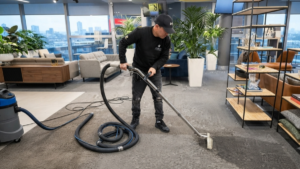
Think about what happens when somebody spills a full mug of coffee on a corridor carpet. Most people blot the surface and move on.
The coffee did not stay on the surface. It went down through the pile, into the backing, and often into the underlay beneath it. Cleaning later removes what is visible at the tip of the tuft and leaves the rest sitting below.
Then the carpet dries. As water evaporates from the top, more moisture is drawn upward through the fibres to replace it, exactly the way a paper towel pulls liquid up its own length. That is capillary action.
The rising moisture brings the old soil with it and deposits it at the very top of the pile, which is precisely where your eye lands.
Why it often looks worse than before
Because the soil is now concentrated.
Before the clean it was spread through the depth of the pile and the backing. After wicking, all of it sits in the top few millimetres, in a tight ring or a hard edged patch.
Same amount of dirt, far more visible.
Why it shows up 12 to 48 hours later
Wicking happens during dry down, not during cleaning. That is why the floor looks flawless when the contractor leaves and disappointing two days later.
The slower the drying, the more time capillary action has to work. A floor that is still damp on Monday morning will always wick more than a floor that was dry by Saturday lunchtime.
Wicking, resoiling, residue or browning: how to tell which you have
| Symptom | When it appears | Where | Likely cause | What fixes it |
|---|---|---|---|---|
| Old marks reappear in the same outline | 12 to 48 hours after cleaning | Exactly where the original spills were | Wicking | Rinse, re-extract with dry passes, force dry |
| Marks return everywhere, dull and grey | Within one to three weeks | Traffic lanes and open areas | Alkaline detergent residue causing rapid resoiling | Clean water rinse with an acidic rinse to neutralise |
| Yellow brown discolouration, no obvious spill shape | 24 to 72 hours after cleaning | Edges, seams, natural fibre rugs, jute backed carpet | Cellulosic browning, lignin migrating from the backing | Acidic browning treatment, then proper drying |
| Colour is in the fibre and does not move at all | Never lifted in the first place | Isolated spots | True dye stain | Assess for spot dye or replacement of that section |
| Damp patch and odour returning repeatedly | Days, then recurring | One defined area, often under desks or printers | Spill source still sitting in the underlay | Lift, extract at source, dry the underlay, then treat |
There is a two minute test you can run yourself before you ring anyone.
Take a clean white towel, fold it into a pad, press it firmly onto the mark and stand on it for thirty seconds.
If colour transfers to the towel, the soil is still mobile and the problem is wicking or residue, both of which are fixable. If nothing transfers and the mark is still clearly there, you are likely looking at browning or a dye stain, which is a different conversation.
Catalin's note. "If a floor is still damp when your staff walk in on Monday, that is not a stain problem. It is a drying problem, and it is ours to fix."
Why over-wetting is the root cause in most Dublin offices
Almost every wicking job we get called into traces back to the same thing. The machine put down more water than it lifted back out.
That happens for a few reasons. Too much solution flow, the wand moved too fast, or, most commonly, nobody did any dry passes at the end.
A dry pass is simply running the wand back over the carpet with the water off and the vacuum on. It costs a few extra minutes per room and it removes a surprising amount of moisture.
On floors we take over from another contractor, the most common thing we find is that nobody did a dry pass at all.
Then there is the Dublin factor, which is real and which the American pages on this subject never account for.
Our humidity is high for most of the year. A carpet that would dry in four hours in a dry climate can take three times that here in November, and Irish humidity and drying conditions from Met Éireann make fairly grim reading if you are trying to dry anything indoors.
Building air handling is the other half of it. Most offices shut their HVAC down outside working hours to save energy, so a Friday evening clean sits in a sealed, still, unheated floor for the entire weekend.
We saw exactly that on a floor in a Sandyford business park cleaned during a wet January week, with the building air handling off from Friday night until Monday morning. No airflow, no heat, no chance.
How long should a commercial carpet take to dry?
- Hot water extraction with proper dry passes and airflow: four to eight hours
- Encapsulation: one to two hours
- Bonnet cleaning: under an hour
- Still visibly damp the next morning: a red flag, and worth raising with your contractor straight away
If a contractor tells you twenty four hours is normal for an office carpet, that is not a technical fact. That is a description of a job done without airflow.
How to fix a wicking stain, step by step
- Stop, and add no more chemical. More product on a wicking patch feeds the problem. This is the point where most people reach for a spray bottle and make the next visit harder.
- Rinse with clean water, or a mild acidic rinse. The goal is to flush out alkaline detergent residue so it stops attracting soil and stops holding moisture.
- Extract with repeated dry passes. Water off, vacuum on, overlapping passes until the wand stops pulling moisture. This is the single most important step.
- Weighted white towel overnight. Fold a clean white towel over the mark, place something heavy on it, and leave it. As the carpet dries, the soil wicks into the towel instead of into the pile.
- Force dry. Air mover angled across the pile rather than straight down, plus a dehumidifier if the room is closed. Airflow matters more than heat.
- Groom the pile. A carpet rake lifts the tufts and opens the pile so air can move through it.
- Vacuum once fully dry. Not before. Vacuuming damp carpet flattens it and achieves nothing.
- Reassess at twenty four hours. If a real stain is still sitting there once everything is dry and clean, treat it as a stain on its own terms rather than repeating the whole process.
What not to do
- Do not scrub. Scrubbing distorts the pile and drives soil sideways.
- Do not use household washing up liquid. It is designed to stay foamy and it leaves residue that guarantees resoiling.
- Do not put a hot iron on it. Heat sets many stains permanently.
- Do not run a hired machine over a patch that is still wet. That is more water into an area that already has too much.
Encapsulation, hot water extraction or bonnet: which method for an occupied office
| Encapsulation | Hot water extraction | Bonnet | |
|---|---|---|---|
| Moisture applied | Low | High | Very low |
| Typical dry time | 1 to 2 hours | 4 to 8 hours | Under 1 hour |
| Soil removal depth | Top and mid pile | Full depth including backing | Surface only |
| Wicking risk | Low | Moderate, high if done badly | Low |
| Best used for | Interim maintenance between deep cleans | Restorative deep clean, spill recovery | Quick appearance lift before an event or visit |
The way we run most Dublin office contracts is encapsulation as interim maintenance through the year, with restorative hot water extraction once or twice annually.
That combination keeps floors looking consistent without soaking them repeatedly, and it dramatically reduces wicking callbacks. Encapsulation is not a cheaper substitute for extraction. It is a different job doing a different thing.
Browning on wool and natural fibre rugs
This one deserves its own section because the fix is the opposite of what instinct suggests.
Many carpets and most quality rugs have jute or other natural fibre in the backing. Jute contains lignin, a natural compound that turns brown in water, especially alkaline water.
When a jute backed carpet gets too wet and dries too slowly, the lignin migrates up into the pile and stains it from below. You get a warm yellow brown discolouration with no spill shape to it, often worst at edges and seams.
We see this most on wool reception rugs and on older carpet in Dublin 4 offices and clinics, where natural fibre is far more common than in newer Docklands fit outs.
The instinct is to clean it again with more detergent. That makes it worse, because detergent is alkaline and alkalinity is what started it.
Browning needs a specific acidic browning treatment followed by fast, controlled drying. If someone offers to "just give it another go" with the same pre-spray, that is the wrong answer.
A real Dublin site example
Back to the IFSC floor.
When we surveyed it, three things were obvious. The residue reading across the walkway was strongly alkaline, so nothing had been rinsed. There was no sign that any dry passes had been done. And the two rings near the printer were still damp underneath, four days after the original clean.
That last one told us the printer spill had gone through to the underlay and had never been touched.
We did it over two evening visits so the floor was never out of use during working hours.
First evening: clean water rinse across the whole walkway to pull the residue out, then repeated dry passes, then weighted white towels placed on the printer rings and left overnight with two air movers running across the pile.
Second evening: lifted the carpet at the printer area, extracted the underlay at source, dried it properly, laid it back and groomed the pile.
Monica took the before and after photographs and noted the moisture reading on the sign off sheet before the team left. That reading is the bit that matters. It is the difference between hoping a floor is dry and knowing it is.
The office manager's comment on the Monday was that the walkway looked better than it had in two years. It probably did, because that was the first time anything had been rinsed out of it.
When to call a professional and when you can sort it yourself
| Reasonable to handle yourself | Worth calling a contractor |
|---|---|
| One small, fresh patch | Marks returning across a whole traffic lane |
| Synthetic carpet, synthetic backing | Wool, jute backed or natural fibre rugs |
| No odour and no damp underfoot | Any odour, or damp you can feel through the pile |
| Rest of the floor is dry | Floor still damp more than a day after cleaning |
| Nothing at stake beyond appearance | A tenant complaint, insurance claim or dilapidations exposure |
A managing agent rang us last year about a tenant complaint on a shared floor. Marks had come back after a clean, the tenant was unhappy, and another contractor had told her the carpet was finished and needed replacing.
It was not finished. It was full of detergent residue and it had never been dried properly.
Two rinse and dry visits later it was fine, at a fraction of what recarpeting an entire floor would have cost her. I mention it because "the carpet needs replacing" is said far too easily, and it is very often wrong.
How to stop wicking at the next clean
- Brief the contractor to do dry passes. Say it out loud before they start. It is a reasonable thing to ask and any good operator will already be doing it.
- Insist on a rinse step and a pH neutral finish. Ask what they rinse with. If the answer is nothing, you now know why your last clean resoiled.
- Book out of hours with a full drying window. Thursday or Friday evening cleaning with no airflow over the weekend is the worst possible combination.
- Keep air moving. Ask the building manager to leave the air handling running overnight after a clean. It costs very little and it changes the outcome completely.
- Treat spills at source, not at the surface. If something goes through to the underlay, blotting the top achieves nothing.
- Move to interim encapsulation between restorative cleans. Less water through the year, fewer callbacks.
- Agree a documented dry down check before the team leaves site. A moisture reading on a sign off sheet, every visit.
Catalin's note. "We schedule carpet work out of hours and we check dry down before we leave. Not because it looks professional, but because a floor that dries properly does not call us back. That is the whole trick."
Cost, timing and compliance in Dublin
We do not publish fixed rates, because the honest cost depends on what the survey finds.
What actually moves the number: total floor area, how heavily soiled it is, whether you need restorative extraction or interim encapsulation, how much furniture has to move, and whether the work is out of hours.
On timing, most of our Dublin office carpet cleaning work happens in the evenings or at weekends. Buildings in the IFSC, the Docklands and Dublin 2 generally need to be fully usable at eight in the morning, so we plan backwards from that.
There is a safety reason as well as a convenience one. A wet floor during working hours is a slip risk you have a duty to manage under the Safety, Health and Welfare at Work (General Application) Regulations, and the Health and Safety Authority guidance on slips and trips publishes clear guidance on it. Employers carry workplace health and safety duties that cover exactly this kind of everyday hazard.
One more thing worth saying plainly. If a contractor cleaned your carpet and it wicked, a reputable one comes back and sorts it without an argument. That is not a favour. That is the job.
Frequently asked questions
Why do carpet stains come back after cleaning? Because they were never fully removed. Cleaning lifts soil from the top of the pile, and as the carpet dries, moisture rises back up the fibres by capillary action and carries the remaining soil with it. This is wicking, and it is reversible.
What is carpet wicking? Wicking is old soil travelling back up carpet fibres during drying and depositing at the tip of the pile. It happens when soil sits deep in the backing or underlay and the carpet dries slowly, usually after over-wetting.
How long does wicking take to appear? Usually twelve to forty eight hours after cleaning, which is why the floor can look perfect when the contractor leaves. Wicking happens during dry down, so the slower a carpet dries, the more pronounced it gets.
Does wicking mean the cleaner did a bad job? Not always, but it usually points to over-wetting, a missing rinse step or no dry passes. Some deep spills wick regardless. Either way, a reputable contractor returns and corrects it rather than telling you it is normal.
How do I get rid of wicking stains? Stop adding chemical. Rinse with clean water, extract with repeated dry passes, place a weighted white towel over the mark overnight, then force dry with an air mover across the pile. Reassess after twenty four hours.
Why did my carpet go brown after cleaning? That is cellulosic browning. Jute and other natural backings contain lignin, which discolours in alkaline water and migrates up into the pile when the carpet stays wet too long. It needs an acidic browning treatment, not more detergent.
How long should carpet take to dry? Four to eight hours after hot water extraction with dry passes and airflow, one to two hours after encapsulation, under an hour after bonnet cleaning. Carpet still damp the following morning indicates too much water and not enough drying.
Is encapsulation better than hot water extraction for offices? Neither is better, they do different jobs. Encapsulation is ideal for interim maintenance with fast dry times. Hot water extraction is the restorative clean that removes deep soil. Most office contracts should use both on a schedule.
Can wicking be permanent? Wicking itself is not permanent damage. The soil is mobile and can be rinsed out. What can be permanent is a true dye stain or long standing browning, which is why diagnosis matters before anyone starts treating.
Why do stains return only in the traffic lanes? Traffic lanes hold the most embedded soil and take the most detergent, so they carry the most residue. Sticky residue attracts new dirt quickly, so lanes go grey again within weeks. That is resoiling rather than wicking.
Get it looked at by someone who will put it right
If your marks came back, please do not attack them with another machine. That is the move that turns a two visit fix into a much bigger job.
Book a free site survey instead. We will identify which of the four faults you actually have, tell you whether it is a rinse and dry job or something more, and quote in writing before anything starts. If your floor needs nothing more than proper drying, we will say so.
Premier Contract Cleaning is a family run contractor based in Dublin 6W, working across the IFSC, the Docklands, Dublin 2, Dublin 4, Sandyford and Leopardstown, offering carpet and rug cleaning in Dublin, office cleaning in Dublin, upholstery cleaning and end of tenancy cleaning as part of our wider commercial cleaning services in Dublin. Out of hours and weekend scheduling, a named account manager, documented dry down on every sign off sheet, and direct access to me rather than a call centre. See what our clients say about working with us.
And if the clean is not right, we come back and do it again, free.
Call 01 963 6655, email enquiries@premiercontractcleaning.ie, or talk to us directly.
Catalin Fatul, Managing Director, Premier Contract Cleaning

The fire itself lasted minutes. An electrical fault in a printer corner of a Dublin 2 office, caught early, out before the fire brigade even finished checking the building. The soot was a different story. The next morning the office manager found a grey film on desks two rooms away and black webs hanging in […]
A few winters ago, our phone rang at ten past six in the morning. A facilities manager on the other end, standing outside a ground floor office near the Dodder, trying to keep his voice level. The water had come in overnight and gone back out on its own. What it left behind was worse […]
A property manager at a multi tenant office block near Grand Canal Dock rang us on a Tuesday, standing in the bin store while he talked. The mixed dry recycling for the whole building had been tagged as contaminated two collections running, with a surcharge attached both times, and now the bin was overflowing into […]