

A showroom manager on a main road on Dublin's southside rang us at 7.40am one morning. He had just opened up to find silver tag lines sprayed across his fascia and a crack running through one glass panel. His first instinct, he admitted later, was to send a staff member out with a bottle of […]
What to Do When Only the Visible Areas Are Being Cleaned
If your cleaners are only cleaning visible areas, they are almost certainly meeting the standard they were given. That standard is visual. It is not a hygiene standard, and the two are not the same thing. Fixing it takes two separate moves: a one-off detail clean to clear the backlog, and a revised specification with named periodic frequencies so the backlog never rebuilds.
We were surveying a 600 m² floor in Sandyford last winter when the operations manager dropped a pen. She went under the desk to get it, put her phone torch on, and stopped talking for about ten seconds. The cable tray had a soft grey layer on it. Behind the pedestal there were crumbs that predated her. Above her head, everything gleamed.
Her first question was whether the cleaners had been coming at all. They had. They had been coming five nights a week for two years and doing exactly what the contract asked of them.
Quick answer: If only visible areas are being cleaned, your contractor is meeting a visual standard rather than a hygiene standard. Run a forty-minute hidden-area audit with a torch, log every finding as in scope, wrong frequency or never in scope, then split the fix into a one-off detail clean for the backlog and a revised periodic schedule for the future.
One thing worth settling before you go further. This article is about a systemic pattern, where the whole approach is built around appearance. If it is only a few specific spots rather than a general pattern, that is a different problem with a different fix, and it is usually a route or rota issue rather than a specification issue.
Appearance clean and hygiene clean are not the same thing
Here is the part that surprises most managers. The surfaces that make an office look clean and the surfaces that make an office hygienically clean barely overlap.
A glass partition is the most visible surface in the building. It is also close to the cleanest, because nobody touches it and nothing lands on it except fingerprints at hand height. Polish it and the whole floor reads as cared for.
Now think about the kitchen tap head. Wet hands, raw food, dozens of people, no visible mark. It looks fine indefinitely. It never announces that it needs attention.
That is the divergence. Appearance cleaning follows the eye. Hygiene cleaning follows the hand. An appearance standard rewards shine on large flat surfaces, because that is what a walk-round inspection can see in ninety seconds. It gives almost no credit for a door handle, and a door handle takes four seconds.
So a contractor optimising honestly against a visual brief will hoover the open floor, empty the bins, polish the glass, wipe the desk tops, and leave. Nobody is cutting corners. The brief simply never asked for the other thing.
| Looks clean and is clean | Looks clean and is not | Looks dirty and is harmless |
| Glass partitions and internal screens | Door handles and push plates | Scuffed skirting and kick marks |
| Polished desk tops in a single-user office | Lift buttons and access panels | Worn carpet in a main walkway |
| Mirrors and splashbacks | Shared keyboards, mice and phone handsets | Ceiling tile watermarks (old and dry) |
| Windows | Kettle handle, fridge handle, microwave keypad | Faded paint above a radiator |
| Vacuumed open floor | Tap heads and soap dispenser fronts | Scratched lift interior panels |
| Emptied and relined bins | Bin lids and pedals, cubicle locks, flush plates | Chipped desk edges |
Read the middle column again. Almost every surface in it is one that someone touches with a hand and then touches their face, their lunch, or a colleague's keyboard. That is what cross-contamination actually looks like in an office, and none of it shows up on a visual inspection.
The compliance point sits underneath this. Regulation 18 of the Safety, Health and Welfare at Work (General Application) Regulations 2007 (S.I. 299/2007) requires a place of work to be kept in a clean state, with dirt and refuse removed as frequently as necessary, and every workroom floor cleaned as frequently as necessary. Read it closely: nothing in that duty is limited to what is visible. The Health and Safety Authority guidance to Chapter 1 of Part 2 of the General Application Regulations is the reference to keep on file, and the full text of S.I. 299/2007 on the Irish Statute Book sets out Regulation 18 in its original wording.
Cleaning is not disinfecting
These are two different jobs and they happen in a fixed order.
Cleaning is detergent plus mechanical action. The detergent lifts soil off the surface, the cloth or pad physically shifts it, and the soil leaves the building. That is what removes the bulk of what is on a surface.
Disinfecting is chemical. A disinfectant kills micro-organisms, but only under two conditions. The surface has to have been cleaned first, because soil and grease shield what is underneath and neutralise many actives. And the product has to be given its stated contact time.
Contact time is where most office disinfection quietly fails. Every disinfectant on the market has a dwell time on the label, commonly thirty seconds to five minutes, and the surface has to stay visibly wet for that long. Spray and immediately dry, and you have cleaned the surface. You have not disinfected it.
So if you see a cleaner wipe a door handle and leave it wet, that is not sloppiness. That is the product being used the way its label requires. Worth knowing before you raise it as a complaint, because we have had that exact complaint raised against a team that was doing it correctly.
Two practical consequences follow. First, disinfection takes longer than most schedules allow, which is why it needs to be specified on named touchpoints rather than everywhere. Second, using a strong product badly is worse than using a mild one well, which is also the thinking behind our reduced-chemical range. If you are reviewing products at the same time, our note on what to avoid using when cleaning covers the combinations that cause damage or do nothing.
Colour-coded cloths belong in the same conversation. Red for washrooms, blue for general areas, green for kitchens and food prep, yellow for washroom hand basins and mirrors, though systems vary slightly between contractors. The point is that a single microfibre carried from a cubicle to a tea station undoes the whole exercise, no matter how good the shine is afterwards.
Ask your contractor for their colour-coding policy in writing. Ask how cloths are laundered, at what temperature, and how many go out on a trolley per shift. A contractor with a real system answers in about twenty seconds. That question tells you more than any inspection score. The HPSC guidance on hand hygiene and environmental cleaning sets out the same colour-coding rationale for higher-risk settings, and it is worth reading even if your office is low-risk by comparison.
The twenty-four touchpoints your contract probably does not name
Print this and walk it. Tick what you can confirm is being done daily.
Entrance and circulation
- Entrance door push plates and pull handles
- Intercom and access control panels
- Lift buttons, inside and out
- Stair handrails
- Meeting room door handles
- Light switches
Desks and IT
- Hot desk keyboards and mice
- Shared monitors and screen bezels
- Phone handsets
- Printer and copier touchscreens
- Printer paper trays and drawer handles
Kitchen and tea station
- Kettle handle and switch
- Coffee machine buttons
- Fridge handle
- Microwave door and keypad
- Dishwasher handle
- Tap heads
- Bin lids and pedals
- Water cooler taps
- Vending machine buttons
Washrooms
- Soap and paper dispensers
- Cubicle locks
- Flush plates
- Hand dryer buttons
And one more that no specification we have ever inherited includes: the cleaner's own trolley handle. It travels through every zone in the building.
Of that list, washroom fittings and kitchen surfaces are usually in scope already. Door handles, light switches and handrails are sometimes in scope and rarely evidenced. Keyboards, mice, phone handsets, printer screens, lift buttons and access panels are almost never named at all, largely because IT equipment sits in a grey area between the cleaning contract and the facilities budget.
Frequency depends on how you work. In a fixed-desk office, personal keyboards can sit on a weekly cycle. In a hot-desking floor where three people use the same station in a week, keyboards, mice and phone handsets move to daily, and so do meeting room door handles and shared monitors. The daily office cleaning checklist is the right place to fix that in writing.
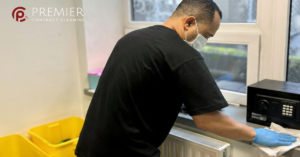
The hidden-area audit: a forty-minute walk
Do this once, properly, at a quiet time. You need a torch, a phone camera, a notepad, and a step stool only where it is genuinely safe to use one.
Safety first, and this is not a formality. Do not climb on chairs, desks or storage units. Do not move heavy furniture, fridges or filing units on your own. Do not open electrical panels, plant rooms, riser cupboards or ceiling voids. Anything you cannot reach standing on the floor or on a stable step stool goes on the list as "needs contractor access", and that is a perfectly good audit result.
Split the floor into zones. Reception and circulation, open plan, meeting rooms, kitchen, washrooms, print and store areas, bin store. Do one zone at a time and finish it before moving on.
Get low, then get high. Torch under desks, behind pedestals, along cable trays and into floor boxes. Then run the torch along the tops of door frames, partition tracks, door closers and the tops of lockers and cupboards.
Check the edges. Skirting, floor perimeters, chair bases and castors, radiator fins and covers, window reveals and sills behind blinds, extract grilles and light diffusers.
Do the awkward three. Behind and beneath the toilet pan and cistern, under and behind the fridge and dishwasher (visually only, do not pull them out), and the bin store itself.
Photograph every finding with something in frame for scale, and note the date. Photographs end arguments that words start.
Score each finding against your current specification, using the table below.
| Score | What it means | Who fixes it |
| In scope and missed | The contract names it and it is not being done | Contractor, at no extra cost, plus a route review |
| In scope at a lower frequency | Named as monthly or quarterly, and the interval is too long for this building | Contractor, by agreeing a revised frequency |
| Never in scope | The specification does not mention it at all | You, by varying the specification, usually at a cost |
Most audits come back with a mix of all three, and the split is the useful output. If nearly everything scores "never in scope", the problem is the document, not the crew.
What to do with the findings
You now have two separate problems, and they need two separate solutions. Treating them as one is the mistake we see most often.
The backlog is the accumulated dirt, and it is a one-off. Two years of dust on a cable tray does not come off in a nightly slot, and asking your existing team to absorb it inside their hours means something else gets dropped. Price it as a standalone detail clean.
The ongoing problem is the specification. That needs periodic frequencies written in by name, with a scored audit that includes hidden areas rather than a visual walk-round. Our page on what a proper office cleaning specification should cover sets out the structure, and what office cleaning actually involves is a useful sense-check against what you are currently buying.
A practical note on the conversation itself. If your contractor offers to clear the backlog free of charge, that is usually an admission that periodic work was priced into the contract and not delivered. That is a fair thing to say out loud, calmly, and most reasonable operators will hold their hands up. We have been on both sides of that meeting.
If they hold the line that periodic work was never included, ask to see where it says so. Then decide whether the gap is worth repricing or whether the contract has simply outgrown its original scope, which happens naturally as headcount and desk-sharing change. Contract terms vary, so take your own advice on your specific agreement before you vary or serve notice on anything.
What a detail clean actually includes
For a Dublin office, a real detail clean covers all of this:
- Full high-level dusting, including tops of door frames, partitions, cupboards, lockers, cable trays, ducting and light diffusers
- Every touchpoint on the list above, cleaned then disinfected with correct contact time
- Under and behind furniture, with pedestals moved and cable trays cleared
- Internal glass, partition tracks and door closers
- Radiator fins, covers and extract grilles
- Kitchen appliance interiors: fridge, microwave, dishwasher filter, kettle descale
- Washroom descale, grout cleaning, and behind and beneath the pan and cistern
- Carpet hot-water extraction, or a machine scrub and reseal on hard floors
- Bin store washdown and deodorise
Now the honest part about time. A 600 m² office detail clean is typically a team of two to three over a weekend. It is not an evening, and any quote that says otherwise is quoting a different job. Our guide on how long it takes to deep clean an office breaks the hours down by area.
Schedule it out of hours if you can. Weekend or split-shift work costs a little more but it lets the team pull furniture out, wet floors properly and leave things drying overnight, which is the only way some of this gets done at all.
Frequently asked questions
What is the difference between cleaning and disinfecting an office? Cleaning uses detergent and physical action to remove soil from a surface. Disinfecting uses a chemical to kill micro-organisms on a surface that has already been cleaned. Disinfectant only works if it stays wet for the contact time on its label, commonly thirty seconds to five minutes. Wipe it dry immediately and you have cleaned, not disinfected.
What are the dirtiest surfaces in an office? The ones people touch constantly and nobody looks at. Door handles and push plates, light switches, lift buttons, shared keyboards, mice and phone handsets, kettle and fridge handles, microwave keypads, tap heads, bin lids and flush plates. They almost never look dirty, which is exactly why an appearance-based clean skips them.
What should be included in an office deep clean? High-level dusting, all touchpoints cleaned and disinfected, under and behind furniture, internal glass and partition tracks, radiators and extract grilles, kitchen appliance interiors, washroom descale and grout, carpet extraction or a hard floor scrub, and a bin store washdown. Anything less than that is a heavier version of a nightly clean.
How often should office touchpoints be cleaned? Washroom and kitchen touchpoints should be daily in any occupied office. Door handles, light switches, handrails and lift buttons should also be daily where footfall is high. In a hot-desking office, shared keyboards, mice, monitors and phone handsets move to daily too, because the surface changes user several times a week.
Why do cleaners use different coloured cloths? To stop cross-contamination between zones. Red is typically washrooms, blue general areas, green kitchen and food prep, yellow washroom basins and mirrors. One cloth carried from a cubicle to a tea station transfers everything it picked up. Ask your contractor for their colour-coding and laundering policy in writing.
How can I check whether my office is properly cleaned? Run the forty-minute hidden-area audit in this article. Torch under desks, along door frame tops, behind the toilet pan, into cable trays and radiator fins. Photograph everything you find, then score each item as in scope and missed, in scope at the wrong frequency, or never in scope. The pattern tells you whether it is a crew problem or a contract problem.
Want a second pair of eyes on it?
Premier Contract Cleaning is a family-run commercial cleaning company based at Mount Argus Mill in Dublin 6W, working across the IFSC, Grand Canal Dock, Ballsbridge, Leopardstown, Blanchardstown, Citywest and the north Kildare commuter belt. Catalin has spent more than a decade in the Irish cleaning industry and still walks the surveys himself.
Our free Dublin site survey includes a hidden-area and touchpoint audit, with photographs, whether or not you move your contract. If there is a backlog, we will price the detail clean separately from the ongoing contract so you can see both.
You also get a written, room-by-room scope before any quote, and a re-clean guarantee on the contract that follows. Call Catalin on 01 963 6655 or email enquiries@premiercontractcleaning.ie. Bring your audit photographs, they make the conversation much shorter.

The fire itself lasted minutes. An electrical fault in a printer corner of a Dublin 2 office, caught early, out before the fire brigade even finished checking the building. The soot was a different story. The next morning the office manager found a grey film on desks two rooms away and black webs hanging in […]
A few winters ago, our phone rang at ten past six in the morning. A facilities manager on the other end, standing outside a ground floor office near the Dodder, trying to keep his voice level. The water had come in overnight and gone back out on its own. What it left behind was worse […]
A property manager at a multi tenant office block near Grand Canal Dock rang us on a Tuesday, standing in the bin store while he talked. The mixed dry recycling for the whole building had been tagged as contaminated two collections running, with a surcharge attached both times, and now the bin was overflowing into […]